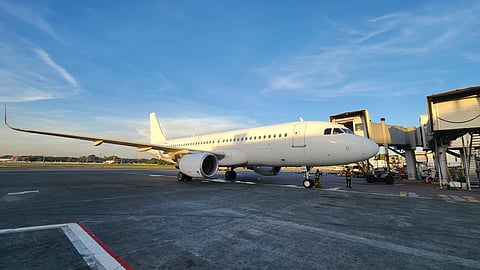


THE growing aviation industry is expected to create more opportunities for aircraft maintenance professionals, but an industry veteran said workers must continuously upgrade their skills to meet increasingly complex aircraft technologies.
Quoting Boeing’s market projection, engineer Ramon Von Possel Jr., head of training at A Plus Technical Training Center, said Southeast Asia will need about 78,000 aircraft mechanics over a 20-year period, or more than 3,000 mechanics annually.
The Philippines, meanwhile, is seeing passenger traffic increase by about 4.06 percent to 62.34 million, further raising demand for qualified aircraft maintenance technicians, he said.
Possel challenged the aviation students to start preparing now as opportunities still abound amid the economic challenges faced by the travel and tourism sectors.
He pointed to the planned development of a new wide-body aircraft maintenance facility in Clark, which he said is expected to be led by Lufthansa, as another potential source of jobs in the sector.
He urged aspiring aircraft maintenance professionals not to wait for new facilities or vacancies to open before preparing for employment.
“Do not wait for the hangar to be there to apply. Prepare yourself now,” he said during the recent Cebu Aviation Summit 2026 on Sept. 25.
Aircraft maintenance work is divided into line maintenance, base maintenance, component shops and avionics, Possel said. Line maintenance involves routine inspections and servicing between flights, while base maintenance covers scheduled, more extensive checks. Component shops handle aircraft parts, while avionics technicians focus on increasingly sophisticated electronic and diagnostic systems.
He said the shift from traditional aluminum aircraft structures to composite materials such as carbon-fiber-reinforced materials is creating new training requirements.
The Philippines, he noted, does not yet have full capability for composite repairs, presenting an opportunity for specialized facilities and skilled workers in the country.
Possel said aircraft maintenance professionals also need stronger diagnostic capabilities as modern aircraft become increasingly capable of detecting and reporting problems before landing.
Essential skills
Beyond technical expertise, he emphasized safety, documentation and communication as essential skills.
“Different environments reward the same habits: safety, traceability and disciplined communication,” he said.
Aspiring aircraft maintenance technicians must obtain a license from the Civil Aviation Authority of the Philippines (Caap) to undergo theoretical and practical examinations and complete the required skills training, he said.
After obtaining a license, technicians should pursue on-the-job training, type training and recurrent training to specialize in particular aircraft families, including Airbus and Boeing models.
Possel noted that a Caap license does not automatically qualify a technician for licenses issued by the US Federal Aviation Administration or the European Union Aviation Safety Agency.
He said obtaining international qualifications can, however, significantly expand employment opportunities overseas.
He also stressed the importance of human factors training, particularly communication, which is now a mandatory component for aircraft maintenance applicants.
Clear communication and the willingness to speak up about safety concerns are critical in an industry where mistakes can have consequences for hundreds of passengers, he said.
“Speak up on safety,” Possel said, encouraging junior technicians to raise concerns even when they involve more senior personnel.
Possel, who has spent decades in aircraft maintenance and previously worked with Philippine Airlines, Lufthansa and SIA Engineering Philippines, said the industry is looking for workers who are not only licensed but also experienced and continuously trained.
He urged students to use the next 12 to 24 months to build practical skills, gain exposure and pursue additional training.
“The market is there, the need is there, but, of course, they will not just be picking you up. They will choose, they will select people who are qualified,” he said.
AI and other technologies
He also cautioned aviation professionals against becoming overly dependent on artificial intelligence (AI) and other emerging technologies.
AI and augmented and virtual reality can improve training and maintenance processes, but technology should remain a tool rather than replace human judgment and technical knowledge, he said.
“Use it as our slave,” Possel said.
For aviation students, he said the message is straightforward — preparation must begin before the opportunity arrives.
“Don’t wait for the opportunity to be there before you start preparing because it will be too late already,” he said. / KOC