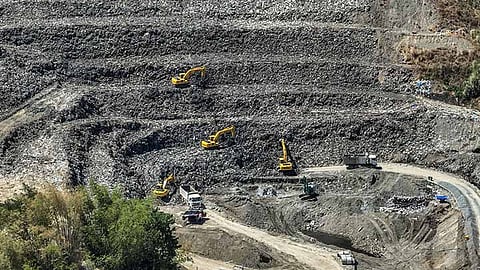


Cebu City Mayor Nestor Archival stated that the Binaliw landfill is not an option for garbage disposal because the operator remains unwilling to accept waste due to unpaid obligations amounting to about P130 million.
The City Government's four attempts to secure a solid waste disposal facility through public bidding failed, leaving the City to continue hauling most of its garbage to Aloguinsan and focusing on source waste-diversion programs.
Mayor Archival sought an additional P500 million after the Binaliw landfill collapse forced hauling to Aloguinsan, and the City Council approved P400 million under Supplemental Budget 1, bringing the 2026 appropriations to about P950 million.
THE Binaliw landfill is not an option for Cebu City’s garbage disposal for now as its operator remains unwilling to accept the City’s waste, Mayor Nestor Archival said.
Archival said the City had asked the operator to accommodate at least 100 tons of Cebu City’s garbage daily, but the request was not accepted.
“They don’t want to accept it yet because we haven’t paid, so we cannot do anything about that for now,” Archival said.
Instead, the City is focusing on reducing the volume of waste it sends to the Aloguinsan disposal facility through waste-diversion programs at the source.
Asked if Binaliw was already out of the picture, Archival said the City had continued to ask the operator to accept even a limited volume of garbage.
“For now, ang ato gyud gihangyo nila nga bisan 100 tons lang, pero dili gyud sila,” he said.
The City Government still has about P130 million in previous obligations to Prime Integrated Waste Solutions (PWS) Cebu, the operator of the Binaliw landfill.
PWS Cebu, however, has clarified that payment of the outstanding amount does not by itself determine whether the facility can accept Cebu City’s garbage.
The City also remains without a garbage disposal contractor after its attempts to secure a facility through public bidding failed to produce a winning bidder.
Cebu City made four attempts to secure a solid waste disposal facility through bidding. PWS participated in the first bidding on May 5, 2026, but was disqualified after its Philgeps registration had expired.
Subsequent bidding dates on July 2, July 21 and Sept. 10 drew no participating bidders.
The latest rebidding had an approved budget of about P99.3 million for the City’s solid waste disposal services.
With Binaliw unavailable, the City continues to haul most of its garbage to Aloguinsan, more than 60 kilometers southwest of Cebu City.
Archival said the City is now focusing on reducing the amount of waste that reaches landfills rather than relying solely on disposal facilities.
“We need to reduce or divert waste from the source going to the landfill,” he said.
The City has started connecting schools and other institutions to its waste diversion efforts. Of around 120 schools targeted by the program, 23 have already been connected, according to Archival.
He also cited Cebu Technological University, with about 26,000 students, as among the institutions participating in the program. The City is initially focusing on collecting plastic waste from schools and preventing it from being sent to landfills.
Archival said the City is also expanding its eco-station program, which currently diverts about 30 tons of garbage daily.
At the City’s current disposal cost of about P6,000 per ton, diverting 30 tons a day represents around P180,000 in potential daily disposal costs avoided.
For 2026, the City initially allocated P550 million for garbage collection and disposal. After the Binaliw landfill collapse forced the City to haul waste to the more expensive Aloguinsan facility, Archival sought an additional P500 million.
The City Council, however, approved P400 million for garbage collection and disposal under Supplemental Budget 1, bringing the 2026 appropriations for the service to about P950 million.
For next year, Archival said the City’s garbage disposal budget would remain at about the same level, while the administration is seeking an additional P100 million specifically for waste-diversion programs in barangays and schools.
Under the proposed program, instead of spending the money solely on landfill disposal and hauling, the City would provide incentives to barangays, schools and students that successfully divert waste at the source.
Archival said students are currently receiving 50 centavos per kilogram for collected waste, with the incentive potentially increasing to P1 per kilogram next year.
The City also plans to use P145 million in infrastructure funding provided by President Ferdinand Marcos Jr. to expand waste-diversion facilities, with the initial goal of diverting another 50 tons of garbage daily.
If the City adds 50 tons to the existing 30 tons diverted through eco-stations, Archival said the City could eventually divert about 80 tons of garbage per day.
The mayor said the City is also seeking the support of the Archdiocese of Cebu and other institutions in expanding the program following a recent eco fair where several groups committed to supporting waste-diversion efforts.
Archival acknowledged that reducing the City’s dependence on landfills would take time.
For now, the City will continue hauling garbage to Aloguinsan while exploring other disposal options, including Toledo City, and expanding programs that reduce waste at its source.
Binaliw had been the City’s primary disposal facility before a Jan. 8 landfill collapse killed 36 people.
The facility later faced regulatory and safety requirements, while the City Government has yet to secure a contractor through its garbage disposal procurement process. / CAV