

CEBU Province is targeting around 15,000 households to be served by proposed bulk water supply systems across five municipalities.
In a statement posted on the province’s Public Information Facebook page on Tuesday, September 8, 2026, the Cebu Provincial Inter-LGU Waterworks Systems Office (CPIWSO) said it currently serves 5,365 connections in Carmen in northeastern Cebu and Moalboal in southwestern Cebu.
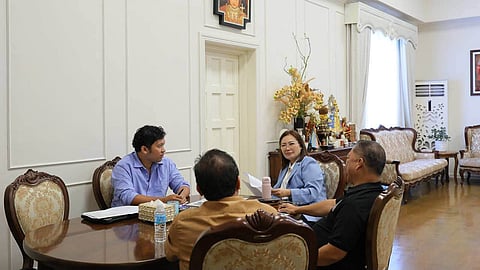
Under plans presented to Gov. Pamela Baricuatro, the agency aims to nearly triple its service coverage to meet the province’s growing water demand.
Expansions
CPIWSO presented proposals for new bulk water systems in Oslob, Barili and Malabuyoc, with completion targeted between 2027 and 2028.
If approved and completed, the expansion would increase the number of active provincial waterworks systems to seven by 2027.
Monthly water revenues are projected to reach P10 million once the planned systems become operational.
The proposed plants in Oslob and Malabuyoc are expected to generate P18 million each annually, while the Barili plant is projected to generate P9 million.
In an April 29 report, SunStar Cebu reported that the Provincial Government aimed to complete seven bulk water projects by late 2026 in preparation for the upcoming El Niño dry season.
The push followed a weather alert from state meteorologists predicting a 79 percent chance of dry conditions beginning between June and August.
CPIWSO Head Aldrin Barade said the projects in Barili, Oslob, San Fernando, Malabuyoc, Alegria, Tabogon and Boljoon are expected to increase water supply across the province.
In the same report, SunStar Cebu reported that Cebu’s current water production meets only about half of local demand. Baricuatro has been deploying emergency funds and water trucks to affected towns as provincial daily water demand is projected to reach 400 million liters by 2033.
Current operations, revenues
CPIWSO currently operates bulk water facilities in Carmen, which produces six million liters per day, and Moalboal, which supplies three million liters per day.
From January to June 2026, revenue reached P1.62 million from the Carmen facility and P22.36 million from Moalboal. At full capacity, annual revenues are projected at P27 million and P44 million, respectively.
Existing facilities are also targeted for upgrades. Improvements are planned for the Carmen and Moalboal plants, alongside the proposed activation of Barili Cluster B to extend service to more villages upon final permit approvals.
Workforce, watershed protection
CPIWSO is currently operating with a lean workforce. Barade requested an increase in personnel from 26 to 115 across its central office and field units.
The office also cited the need to establish a water resources monitoring network to better manage local water sources.
Baricuatro emphasized that infrastructure growth must be paired with environmental conservation, pointing to watershed protection as a vital component of provincial water security.
“You’re really the key sa atong success,” Baricuatro told waterworks officials during the presentation.
To fund conservation efforts, Engineer Noel Tabasa proposed establishing or reconstituting a Cebu Watershed Authority. The proposal includes a mechanism that would allow the province to collect a water levy from private contractors operating in Cebu.
In an earlier SunStar Cebu report, the Provincial Government said it planned to reactivate the Provincial Water Resource Authority as the central policymaking body for local water sourcing and distribution.
Elizar Sabinay of the Provincial Planning and Development Office said reactivating the agency would avoid legislative redundancy, as the existing body already has a comprehensive water code and implementing rules and regulations.
Sabinay said a functional authority would help address fragmented governance among various agencies, manage bulk water distribution and oversee major infrastructure projects, including proposed surface water dams valued at more than P7 billion each. (CDF)
