

PDRRMO Head Dennis Pastor stated that recovery remains far from complete a year after the Sept. 30, 2025, earthquake, with the Provincial Government fulfilling its P750-million share of a broader P19.28-billion recovery program.
Gov. Pamela Baricuatro stated that only about 20 percent of the National Government funding has been provided so far, while the Province has allocated P269 million for temporary learning spaces.
The P19.28-billion recovery requirement covers four major sectors: P10.13 billion for social, P2.83 billion for infrastructure, P1.98 billion for productive, and P4.29 billion for cross-cutting sectors.
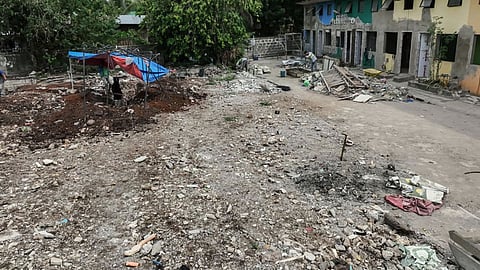
A YEAR after the magnitude 6.9 earthquake struck northern Cebu, recovery remains a work in progress, with the Provincial Government fulfilling its P750-million share while the broader P19.28-billion recovery program continues under a three-year plan.
“So, we are still far off in terms of recovery, but we are doing our best,” Provincial Disaster Risk Reduction and Management Office (PDRRMO) Head Dennis Pastor said in a mix of Cebuano and English in an interview with the media on Wednesday, Sept. 30, 2026.
The Sept. 30, 2025, earthquake affected 10 municipalities and one city in northern Cebu, resulting in an estimated P19.28 billion in recovery needs, according to the Post-Disaster Needs Assessment (PDNA).
Initial recovery funds
Pastor said the Provincial Government’s P750-million commitment represents its share of the overall recovery cost, while National Government agencies are responsible for projects under their respective mandates.
He said the plan is to implement a set of three-year plans since it will take time.
Based on a Feb. 1 SunStar Cebu report, the Provincial Government had earlier identified P708.1 million for initial recovery efforts based on the PDNA report.
According to the report, the funding sources for the recovery efforts are the Provincial Government, implementing agencies and funding agencies.
The initial allocation included P311 million for agriculture and fisheries, P254.1 million for the repair of 13 bridges and P143 million for tourism recovery.
Pastor said the Province’s commitment was later increased to P750 million to cover its share of the broader recovery requirement.
“For the part of the Province, the governor will really comply with her commitment and her obligation for the recovery cost of P750 million,” he said in a mix of Cebuano and English,
SunStar Cebu continues to request a full copy of the PDNA report from the PDRRMO.
Multibillion-peso requirement
The P19.28-billion recovery requirement covers four major sectors backed by implementing and funding agencies.
The social sector accounts for P10.13 billion, including housing, schools and health services; infrastructure requires P2.83 billion, covering roads, bridges and ports; productive sectors need P1.98 billion, encompassing trade, industry and tourism; and cross-cutting sectors require P4.29 billion for governance and environmental concerns.
The PDNA also recorded P9.24 billion in physical damage and P47.74 billion in economic losses from the earthquake.
National Government agencies are expected to fund and implement projects under their respective mandates.
Pastor cited schools under the Department of Education (DepEd), housing under the Department of Human Settlements and Urban Development (DHSUD), roads and bridges under the Department of Public Works and Highways (DPWH) and ports under the Philippine Ports Authority.
“Because schools belong to DepEd, housing belongs to DHSUD, roads and bridges belong to DPWH, ports belong to the Ports Authority,” he said in a mix of Cebuano and English.
“There is an implementing agency, there is a funding agency,” he said in Cebuano.
Among the identified National Government commitments are P6.03 billion from DepEd and P4.37 billion from DPWH.
Gov. Pamela Baricuatro said only about 20 percent of the National Government funding had been provided so far.
“I think it is still around 20 percent. It is still small. Not everything has been given yet,” she said in a mix of Cebuano and English.
Pastor said the Province has already implemented portions of its commitment, including agricultural recovery, bridge repairs and temporary learning spaces.
School and road repairs
Schools and roads account for some of the largest portions of the recovery requirement.
Pastor said more than 3,000 classrooms were damaged in the earthquake, including those with minor damage that could no longer be used.
The Provincial Government allocated P269 million for temporary learning spaces so affected students could continue attending classes while permanent school reconstruction falls under DepEd.
Pastor said about 40 percent of the temporary learning centers had been completed or were ongoing.
DepEd has committed P1 billion for school reconstruction, according to provincial officials, although the governor said the funding had not yet been fully released.
DPWH, meanwhile, is handling the reconstruction of damaged roads and bridges. The Province separately committed funding for 13 bridges under its own recovery program.
Disaster preparedness shift
The earthquake also prompted changes in the Province’s disaster preparedness system.
Baricuatro said the PDRRMO had only three personnel when her administration took over but now has nearly 100 personnel, along with a new center in Busay and additional rescue equipment.
“We are more prepared than we were before,” Governor Baricuatro said.
The Province is also procuring two forward warehouses for the prepositioning of food, non-food items and equipment in northern and southern Cebu. A satellite PDRRMO office is also planned for eastern Cebu.
Pastor said communication systems with local government units (LGUs) have been strengthened, incorporating the use of high-frequency communication and direct links with LGUs.
For the governor, the main lesson from the earthquake was preparedness.
“Preparedness. Preparedness, so that’s why now, it’s an opportunity to strengthen our PDRRMO, that we are really prepared in case of disasters, that our quick response really matters,” she said in a mix of Cebuano and English.
Pastor said national disaster agencies are trained to respond to multiple hazards, but resources remain a concern because of the scale of damage caused by disasters.
“So, the more we should invest on disaster preparedness,” Pastor said. / CDF