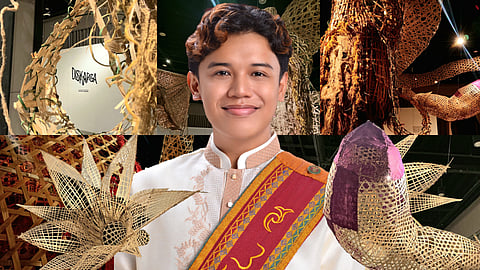

Before the first cut of the blade, bamboo already remembers. Long before its fibers are stripped, soaked and coaxed into soaring architectural arcs, it has braced farmhouses against mountain squalls, carried the yield of upland soil and absorbed the calloused oils of working hands. For Cebuano visual and installation artist Van Gabud, that history isn’t just raw material. It is the pulse of the work itself.

“A painting begins with a blank canvas, and its meaning gradually develops through the process,” Gabud said. “With bamboo, I felt like I was starting with a material that already carried its own history. It has been part of our everyday lives — for farming, architecture and countless practical uses — and these experiences stay with the material. I became interested in asking what happens when bamboo is taken out of those familiar roles and brought into a gallery or public space. How do people begin to see it differently?”
The origin of that question lies far from the pristine white cube of an exhibition hall. It begins high above the sprawl of the city in Adlaon, a mountain barangay in Cebu where the soil clings rich and red to the soles of your feet. There, Gabud’s family coaxed a livelihood out of the hillside, cultivating neat rows of corn, tomatoes and eggplants. In Adlaon, the bakat — a utilitarian bamboo basket woven loose and deep to cushion heavy harvests — was as common as breath.
Then came the fracture. A sudden, jarring incident forced his family to abandon their home, cutting ties with the land they had worked for generations.
The vessel back to Adlaon
Years later, while completing his final terms in art school, Gabud found that while his feet had moved forward into the urban landscape, his mind was quietly turning around. “During the final year and a half in art school, I found myself wanting to return — not geographically, but through a material,” he recalls. “Whenever I see bamboo strips, I remember the bakat we once used. It was a simple object, but for me it became a vessel that could carry me back to those memories.”
Reclaiming that memory wasn’t simple nostalgia; it was a physical trial. Gabud did not inherit weaving through family bloodlines. He approached the discipline as an outsider conscious of its ancestral weight, refusing to treat an ancient Cebuano craft as a mere aesthetic gimmick.
“I didn’t want to simply borrow a practice without understanding it,” Gabud said. “But as I spent more time with the practice, I realized that farming and weaving are much more connected than we often think. Farmers rely on baskets like the bakat, yet we rarely stop to think about the hands that wove them. That realization made me see that the relationship between the two practices was never distant; it was just overlooked. Both farming and weaving demand patience, repetition and care.”
He spent grueling months with the fiber, learning the brutal mathematics of splitting culms, testing green wood against dry and teaching his palms to endure the razor edges of untreated cane. “As I worked with bamboo, I realized that its lightness, pliability and natural tension made it capable of creating forms that felt both delicate and structurally strong,” he said. “Those qualities allowed me to bend, weave, suspend and expand the material into immersive installations while still preserving a sense of movement and openness.”
Unloading the weight
That hard-won mastery coalesced into DISKARGA, Gabud’s landmark exhibition mounted at The Kabilin Center.
The title evokes the visceral clamor of dawn at Cebu’s Carbon Public Market, where a young Gabud once walked closely behind his mother as she sold their harvest of upland vegetables. Amid the exhaust, the wet concrete and the shouts of traders, one phrase echoed constantly above the din: “Padiskarga ko.” A vendor called out to the kargador to shoulder the sacks, unburden the trucks and haul the heavy harvest onto waiting pushcarts.
“Growing up, I never imagined that this ordinary phrase would one day become the title of my exhibit,” Gabud says. “In DISKARGA, the farmer, the vendor and the kargador become the inspiration of the process and the output. Although the labor that I experienced in making this work is nothing to what they do every day, through making, I wanted to pay tribute to their work in the way I know best.”
Yet stepping into the gallery, one immediately realized the unloading went both ways. “I realized that this exhibition became my own form of diskarga — not of vegetables or baskets, but of memories and experiences I had been carrying for a long time.”
An embrace in the gallery
Inside The Kabilin Center, the installation refused to sit quietly against flat walls. Instead, Gabud allowed the architecture of heritage to breathe alongside his woven forms. Giant ribbed structures curled like spine and rib cages through the air, curving into gestures that felt undeniably like an embrace. The gallery air took on the faint, sweet dryness of cured wood. Gabud didn’t build an object to be admired at arm’s length; he built an environment that demands bodily presence.
“I’ve always wanted people to encounter the work with their bodies, not just their eyes,” he said. While tight schedules kept him from fully realizing an interactive setup where gallery visitors wove directly into the bamboo alongside him, the physical dialogue remained intact. Visitors stepped inside the ribs of the structure, ducking under arches, brushing shoulders against tensioned slats. “The installation still invites people to move through it, feel its textures and become enveloped by the space. That embodied encounter became another form of participation, although quieter, but for me, it is still a meaningful collaboration on its own.”
Running beneath every curve of DISKARGA is a tender thesis on the nature of toil. In a world that often separates art from manual labor, Gabud insists they are bound by the exact same ethic: “A farmer tends crops every day with the hope of a good harvest, while a weaver carefully places each strip with attention and intention. Although both involve physically demanding labor, what truly connects them is care. Without it, neither the harvest nor the basket can exist.”
Rooted in the living
As the exhibition lights dim on DISKARGA, Gabud is already looking outward, turning his gaze back to the soil. His next creative chapters will delve into botanical installations, allowing living vegetation and raw regional flora to enter his spatial vocabulary. For an artist whose work blossomed from the pain of displacement, creation has become a way to remain permanently rooted.
“Instead of asking, ‘What new material should I use?’ I began asking, ‘What stories are already embedded in the materials we often overlook?’” he said. “I don’t know exactly where the work will lead me next, but I hope I never lose the curiosity to explore or the privilege of continuing to create. I hope the desire to create never stops burning.”
Some contemporary art scenes often draw to spectacle and abstract theory, Gabud’s practice stands as a deeply grounded act. By shaping humble bamboo into shared spaces of reflection, he shows that art does not need to break away from its roots to feel current. Through every knot, arch and grain, he reminds us that the burdens we carry — history, displacement and sweat — can be set down, reshaped and turned into forms of shelter and quiet beauty.
“Moving forward, I want to continue researching local materials and discovering how they can become part of my artistic language.”
“I’m particularly interested in exploring botanical installation and creating works that grow from what is already present in our surroundings. More than anything, I hope to keep making work that helps people reconnect with place, memory and the quiet experiences that keep us grounded,” he added.