

AN OUTBREAK of crown-of-thorns seastar (Cots), a coral-eating predator, is devastating coral reefs in seven barangays in Asturias town in western Cebu, threatening fish, tourism and the livelihood of local fisherfolk.
Municipal Environment and Natural Resources Office (Menro) head Joann Rosario, in an interview on Thursday, July 10, 2025, said the spiny predator has reached outbreak levels in parts of the town’s marine protected areas (MPA), particularly in San Roque Coral Garden, where a dense population was confirmed during a monitoring dive in June.
“This directly affects not only the corals themselves, but also the entire marine ecosystem,” she said.
Rosario said Cots consume live coral polyps, weakening reefs that are vital for marine life’s breeding and shelter.
A single Cots can destroy up to a square meter of coral daily, leading to rapid and potentially irreversible damage.
While precise measurements of the damage are still being finalized through ongoing profiling and monitoring, Rosario said several coral patches in San Roque show visible degradation, especially among fast-growing branching corals.
She said the coral loss not only threatens biodiversity, but also affects fish stocks and food supply for coastal communities.
The Cots outbreak in Asturias was formally documented through a national research project led by the Department of Environment and Natural Resources-Ecosystems Research and Development Bureau-Coastal Resources and Ecotourism Research, Development and Extension Center.
Asturias was selected as a pilot site, enabling Rosario’s team to begin quarterly monitoring and data collection.
Rosario indicated that a decline in natural Cots predators, such as triton shells and hawksbill turtles due to overfishing, may contribute to the outbreak.
Environmental stressors like nutrient runoff and rising ocean temperatures also exacerbate the problem, as Cots thrive on stressed corals.
Measures
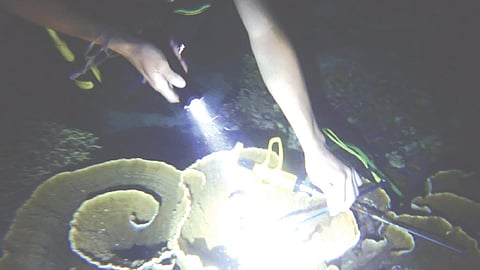
Local authorities, with assistance from trained divers and partner agencies, employ a vinegar injection method to control the Cots population during both day and night dives.
However, resource limitations hinder these efforts. The team operates with only two dive masters, two MPA watchers, one pump boat, two sets of scuba gear and eight tanks.
The tanks require refilling in Lapu-Lapu City due to the absence of a local compressor.
Monitoring activities were suspended this month due to rough seas, but will resume when conditions improve.
The team continues coral profiling to assess population trends and reef recovery.
Despite the Cots proliferation, Asturias’ marine tourism remains active, considering the town is recognized as an emerging dive destination in Cebu.
The local government has implemented stricter reef protection protocols, including mandatory pre-dive briefings on conservation, restricted access during Cots removal operations and the distribution of QR codes for real-time Cots reporting by the public.
Rosario said local tour operators and resort owners are actively engaged in supporting reef watch efforts, integrating conservation into tourism practices.
Long-term plans
Rosario said the local government unit is working with DENR, nongovernment organizations and academic institutions to implement long-term solutions, including coral rehabilitation and reef management, training more community divers, exploring the repopulation of natural Cots predators, strengthening MPAs and continued research on early detection systems.
Efforts are also underway to secure additional funding and equipment, alongside raising local awareness.
Beyond the science, Rosario said the emotional toll of the work is heavy.
“We really see it firsthand — corals that have turned white, lifeless. It’s heartbreaking. But we remain hopeful. If we unite, there’s hope,” said Rosario.
She also urged the residents to help by reporting sightings, disposing of waste properly and supporting reef-friendly practices. / CDF