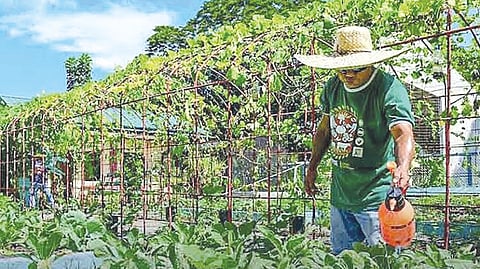


THE Department of Agriculture (DA) is encouraging overseas Filipino workers (OFWs) planning to return home to consider agribusiness as a second career and investment option, while gaining exposure to modern farming technologies that could be adapted in the Philippines.
The initiative seeks to channel the capital, skills and business experience acquired by OFWs abroad into the Philippine agriculture sector, as the government works to expand the pool of agripreneurs.
Agriculture Secretary Francisco Tiu Laurel Jr. said returning OFWs could contribute to the country’s food security by investing in agriculture.
“We want our OFWs who are preparing to come home to see agriculture not just as a business they can build, but as an opportunity to contribute to food security and nation building,” Laurel said in a statement.
The forum, led by DA assistant secretary for Agribusiness, Marketing, and Consumer Affairs Genevieve Velicaria-Guevarra and Overseas Workers Welfare Administration (Owwa) administrator Patricia Yvonne “PY” Caunan, introduced OFWs to government programs on financing, training and market linkages.
“Agriculture is not only vital to our food and nutrition security; it also offers returning OFWs opportunities for entrepreneurship, investment and sustainable income,” Guevarra said.
“Agriculture today is no longer limited to traditional farming, but is a dynamic technology-driven business sector,” she added.
Agricultural Credit Policy Council executive director Rallen Verdadero discussed financing options, while the Agricultural Training Institute presented training and capacity-building programs.
The DA and Owwa also signed a memorandum of agreement to strengthen the delivery of agriculture-related programs and services to OFWs.
The initiative builds on a 2025 DA order that identified OFWs as potential agribusiness investors and entrepreneurs.
In Wanju, South Korea, the Philippine delegation visited the county agricultural technology center and a strawberry smart farm employing eight Filipino seasonal workers from Mina, Iloilo.
The farm uses environmental controls, fertigation, fogging, automated pest-control and air-circulation systems, providing Philippine officials and workers with exposure to technologies that could potentially be adapted locally.
Wanju currently hosts 278 Filipino seasonal workers from six Philippine local government units.
The DA is also exploring opportunities for qualified young farmers to join technology-exposure programs in South Korea through the Young Farmers Challenge Program, in coordination with the Department of Migrant Workers and local governments.
The program is intended to help turn OFWs’ overseas work experience, capital and exposure to technology into resources for agribusiness ventures when they return to the Philippines. / KOC