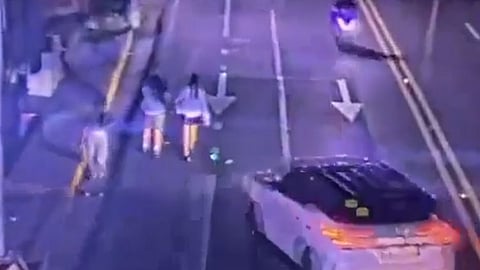


Ralph Antony Go faces three formal charges after his SUV struck and killed Criza Jean Concha Livingstone and injured her American husband, John Charles Livingstone, along General Maxilom Avenue on Monday, Sept. 21, 2026.
Go is detained at the Traffic Enforcement Unit’s temporary custodial facility pending bail arrangements after undergoing an online inquest on Sept. 21 for violating the Anti-Drunk and Drugged Driving Act and abandonment.
Cebu City councilors questioned the need for a local anti-drunk driving measure during a public hearing on Tuesday, Sept. 22, while traffic officials pushed for stronger enforcement rules for alcohol-serving establishments.
THE driver of a sports utility vehicle that struck a bar worker who died and injured her American husband along General Maxilom Avenue early Monday, Sept. 21, 2026, has been formally charged with three cases before the prosecutor’s office.
Lt. Col. Jomar Medil, chief of the Traffic Enforcement Unit (TEU) of the Cebu City Police Office, said the charges filed were reckless imprudence resulting in homicide in connection with the death of Criza Jean Concha Livingstone, 27, and physical injuries in connection with the injuries sustained by her husband, John Charles Livingstone, 56, an American national. The cases were filed Tuesday, Sept. 22.
Earlier, on Monday, Sept. 21, at 5 p.m., an online inquest proceeding was held against Ralph Antony Go in connection with his alleged violation of Republic Act 10586, or the Anti-Drunk and Drugged Driving Act of 2013, as well as abandonment. The TEU is awaiting the filing of the corresponding information.
Medil explained that aside from the criminal cases, Go will also face a separate case before the Land Transportation Office 7, including the possible revocation of his driver’s license and the issuance of an alarm for the plate number of his vehicle.
Go remains detained at the TEU’s temporary custodial facility while arrangements for bail are being processed.
CCTV footage showed the SUV veering into the opposite lane and hitting the couple before leaving the scene. Police said Go told investigators he became drowsy and lost control of the vehicle, while a breathalyzer test showed that he had alcohol in his system.
No need for new measure
Meanwhile, Cebu City councilors questioned the need for a local anti-drunk driving measure despite an existing national law during a public hearing Tuesday, Sept. 22, as traffic officials pushed for stronger prevention, including requiring alcohol-serving establishments to help keep intoxicated patrons off the road.
Drunk-driving apprehensions
Cebu City Transportation Office (CCTO) assistant head Ken Jongoy said they recorded about 20 drunk-driving apprehensions this year using two breathalyzers donated by the Land Transportation Office Central Office.
Of these, 17 resulted in convictions and one was dismissed. The TEU also recorded about 20 traffic incidents involving motorists who admitted consuming alcohol or were found to have alcohol levels beyond the safe threshold under Republic Act 10586, or the Anti-Drunk and Drugged Driving Act.
Councilor Sisinio Andales questioned the need for a local measure when RA 10586 already imposes penalties.
Jongoy said enforcement by CCTO personnel depends on their deputation by the LTO. When deputation is revoked for assessment or auditing, CCTO personnel cannot enforce the national law and must rely on the City’s outdated local provision, which carries only a P1,000 fine.
Jongoy recommended three measures: making patron safety a standard responsibility of alcohol-serving establishments, creating a localized anti-drunk driving law and amending the city’s existing traffic code provision on intoxicated driving.
Under Councilor Pablo Labra II’s proposed Responsible Alcohol Service Ordinance, establishments would have to stop serving visibly intoxicated patrons and help arrange safe transportation, contact companions or family members, or provide a waiting area until transportation is arranged.
The proposal covers bars, restaurants, hotels, nightclubs, videoke establishments and similar venues.
The measure would also require responsible alcohol service training for managers and frontline staff. Penalties range from P3,000 for a first violation to P5,000 and a 15-day suspension for third and subsequent violations.
The council’s committee on laws, ordinances and styling, however, recommended revisions, including clearer definitions of “visible intoxication,” specific prohibited acts and penalties, and due process for business suspensions.
Lt. Col. Oliver Blanya of the Highway Patrol Group said implementation would also require properly calibrated breathalyzers and trained personnel.
The proposed local measures remain subject to further review and legislative action by the Cebu City Council. / AYB, CAV