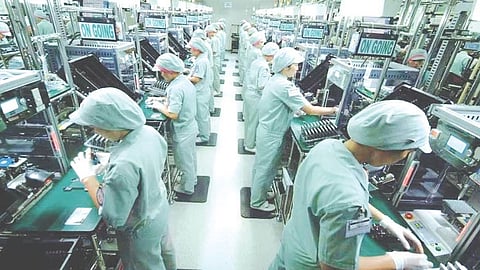


ELECTRONICS and semiconductors are pushing Philippine merchandise exports to record levels and the government is using the momentum to steer investors toward higher-value work beyond assembly.
Merchandise exports reached an all-time high of US$64 billion in the first eight months of 2026, driven largely by the electronics sector, according to the government.
Executive Secretary Ralph Recto, who chairs the Semiconductor and Electronics Industry Advisory Council (Seiac), said the figures show progress on President Marcos Jr.’s directive to move the country beyond assembly into higher-value activities.
“Nakikita na ng mga investors na isa tayong investment choice hindi lang para sa manufacturing at assembly kundi pati na rin sa chip design, engineering, research and innovation,” Recto said.
(Investors now see that we are an investment choice not only for manufacturing and assembly, but also for chip design, engineering, research and innovation.)
He added that rising demand for artificial intelligence (AI), semiconductors and data centers is widening opportunities for Filipino workers, engineers and businesses.
Record month
The Philippine Statistics Authority reported that exports in August alone rose 27.8 percent from a year earlier to US$9.1 billion, a 35-year high for a single month. Electronic products accounted for US$6.2 billion, or 68 percent of the total.
For January to August, electronics exports grew 26.2 percent to US$37.1 billion. The United States remained the top destination, taking US$12.3 billion in goods, almost a fifth of total exports for the period.
Industry raises forecast
The Semiconductor and Electronics Industries in the Philippines Foundation, Inc. (Seipi) raised its 2026 electronics export growth forecast to 10 percent, or about US$54 billion, citing global demand for AI and data-center infrastructure. It credited the CREATE MORE Act, particularly provisions that help registered export enterprises, for strengthening the incentives framework.
As an example, the government cited Toshiba’s planned multi-billion-peso expansion of its Philippine operations over the next three years. The company will ramp up production of high-capacity hard disk drives used in data centers, creating about 3,000 jobs.
Roadmap to 2030
Seiac recently launched the Philippine Semiconductor and Electronics Industry Roadmap, which targets US$110 billion in annual exports by 2030. By then, the government aims to raise the country’s share of global semiconductor assembly, test and packaging from four percent to seven percent and capture four percent of global electronics manufacturing services.
Building an integrated circuit (IC) design sector would add US$2 billion to US$3 billion in annual export receipts.
Corridors and hubs
The Luzon Economic Corridor, a Subic-Clark-Metro Manila-Batangas link, will draw public and private investment in transport, logistics, energy, digital infrastructure and advanced manufacturing. It aims to create up to one million jobs, including a forecast 130,000 from a 1,600-hectare technology and advanced manufacturing hub in New Clark City.
The Board of Investments is also advancing a broader Philippine Technology Corridor linking industry hubs nationwide:
Advanced manufacturing in New Clark City
IC design in Metro Manila
Critical minerals in Mindanao
AI infrastructure in Batangas
Connectivity in Aurora
Prospective wafer fabrication in Bulacan
The government said these efforts depend on better infrastructure, Filipino talent development, predictable rules and fair and fast resolution of investment bottlenecks. / MVG