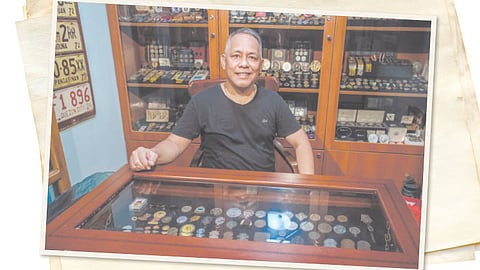


For Renante Rubio of Lapu-Lapu City, medals are more than pieces of metal. Each one carries a story, of a person, an achievement, a war, a celebration or a chapter in Philippine history.
His fascination with collecting began at home.
Rubio was captivated by the medals of his grandfather, a World War II veteran. His curiosity grew as he also discovered his father’s collection of coins and medals. By the time he was in his 20s, after graduating, Rubio had begun building a collection of his own.
What started as an interest eventually became a lifelong pursuit covering a wide range of Philippine history.
His collection includes war medals, Philippine Carnival medals, Commonwealth-era pieces, religious medals, Spanish colonial medals, pieces connected to the Spanish-American War and school medals. He has also acquired World War II artifacts, including pilot caps and canteen caps.
Historical finds
Among the pieces that have become particularly meaningful to him are a rare Homma medal and a 1908 Philippine Carnival medal.
The Homma medal is associated with Japanese Lt. Gen. Masaharu Homma and the Japanese campaign in the Philippines during World War II. Historical and numismatic references document medals bearing Homma’s name that were produced in Manila during the Japanese occupation. Some surviving examples are particularly scarce, making them objects of interest among collectors of Philippine medals and World War II memorabilia.
The 1908 Philippine Carnival medal, meanwhile, connects Rubio’s collection to one of the major public events of the American colonial period.
The Philippine Carnival formally began in Manila in 1908, evolving from earlier carnival and exposition activities. It became an annual celebration featuring exhibitions, competitions, parades and displays intended to showcase the Philippines and its people during the American colonial period.
For Rubio, owning such a medal is like holding a small piece of that era.
But the value of a medal, he believes, is not simply measured by its rarity or price.
“Collectors are the real preservers and keepers of history,” Rubio said.
Unlike ordinary coins, which circulate from one person to another as part of everyday transactions, medals are often produced for a particular occasion or given to a specific person in recognition of an achievement, service or contribution.
That personal connection makes them different.
A medal may have been awarded once, to one individual, for something that happened at a particular moment in history. When that medal disappears into a private collection, its story can disappear with it.
Starting a collection
Rubio believes collectors therefore have a responsibility not only to acquire these objects but also to understand and preserve their stories.
He encourages those who want to enter the hobby to join collector groups, attend talks and exhibits, read books and learn from people who have spent years studying coins, medals and antiques.
“Be with people,” Rubio said, emphasizing that collecting becomes more meaningful when knowledge is shared among enthusiasts.
For him, collecting is not simply about finding something rare.
It is about the thrill of discovery, the moment an unusual medal turns up, the research that follows and the realization that the object in one’s hand may have passed through generations before reaching his collection.
Some pieces may never appear again once they leave the hands of their original owners.
That is what makes the search worthwhile.
“Rare coins, medals or antiques are like love,” Rubio said. “You cannot find them anywhere.”
For Rubio, every medal is a reminder that history does not always live inside museums or textbooks.
Sometimes, it survives quietly in the hands of collectors, waiting to be discovered, understood and passed on to the next generation.