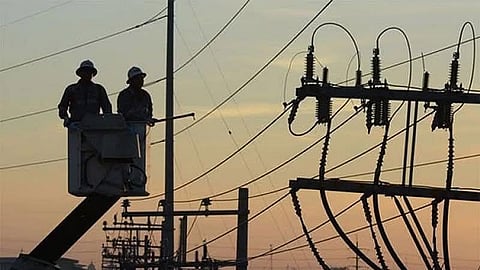


THE Cebu Energy Rights Advocates (Cera) is urging local governments in Negros and Bohol to review their bans on coal-fired power plants, warning that increasing dependence on imported baseload electricity is adding pressure to the interconnected Visayas grid.
Cera convenor Nathaniel Chua said the growing power requirements of Negros and Bohol are being supplied largely by generation from Cebu, Panay and Leyte, even as these areas face rising demand of their own.
“Demand for power is shared by one Visayas grid; therefore, the responsibility for the burden of baseload supply must also be shared,” Chua said in a statement.
Baseload refers to the minimum continuous level of electricity demand on a power grid that must be met around the clock.
Negros Occidental, Negros Oriental and Bohol adopted ordinances in 2019, 2018 and 2018, respectively, prohibiting the construction of coal-fired and diesel power plants within their jurisdictions.
Cera said these policies have contributed to the islands’ dependence on power imports, particularly during periods of peak demand.
Negros has more than 950 megawatts (MW) of installed capacity, but much of this comes from solar generation, which Cera said cannot provide dependable supply during evening peak periods.
The island has about 240 MW of baseload capacity from the Palinpinon geothermal plants, against peak demand of roughly 450 MW, according to Cera.
Bohol faces a larger supply gap, with peak demand exceeding 100 MW compared with only about 26-30 MW of dependable in-island capacity, Cera said.
The resulting shortfalls are supplied through the interconnected grid, including coal-fired generation in Cebu and Panay and geothermal power from Leyte.
Chua said the arrangement is becoming increasingly difficult as Cebu and Panay experience rapid economic and electricity demand growth.
“Cebu and Panay are being forced to consider building even more coal plants just to support their own demand but also the demand of the region,” he said.
He added that Leyte and Samar are expected to retain more of their geothermal generation as their economies expand, potentially reducing the amount of excess power available to other parts of the Visayas.
“Unless Palinpinon in Negros expands, our next best solution is to build coal power plants for our baseload needs for the medium term,” Chua said.
Supply conditions still tight
Cera’s call comes as supply conditions in major Visayas islands remain tight. Panay is projected to reach peak demand of about 600 MW by late 2026, compared with dependable in-island supply of around 500 MW, while Cebu’s peak demand has exceeded 1,000 MW against about 700 MW of in-island generation capacity, according to the group.
Both islands have new coal-fired power projects in the pipeline.
Leyte and Samar remain the only major Visayas areas with a significant generation surplus, with about 700 MW of largely geothermal supply against peak demand of roughly 310 MW. Cera, however, said demand in the area is also growing.
The Visayas grid has overall demand of about 2,400 MW and is linked to Luzon and Mindanao through submarine transmission connections.
Cera said the limited capacity of these interconnections, combined with constraints in inter-island transmission, limits the ability of the region to rely on power imports during periods of tight supply.
The group warned that continued dependence on imported baseload power without sufficient 24-hour local generation could put additional strain on transmission infrastructure and increase the risk of another region-wide power crisis.
The group said local governments should consider the reliability and physical limitations of the interconnected grid when formulating provincial energy policies.
The Visayas power grid remains under pressure from limited generation capacity, with the grid operator declaring another yellow alert on Monday, Sept. 28, 2026.
The National Grid Corp. of the Philippines (NGCP) placed the Visayas grid under yellow alert from 5 p.m. to 7 p.m. on Sept. 28, citing insufficient operating margin to meet the grid’s contingency requirement.
Available capacity was estimated at 2,572 megawatts (MW) against peak demand of 2,374 MW.
NGCP said 14 power plants were on forced outage in September, while others had been unavailable since previous years. Another 15 plants were operating at derated capacities, resulting in a total of 928.3 MW unavailable to the grid.
The latest alert was partly attributed to the unavailability of major coal-fired generating units, including Panay Energy Development Corp. Unit 3, Kepco SPC Power Corp. Unit 2 and Therma Visayas, Inc. Unit 1. / KOC