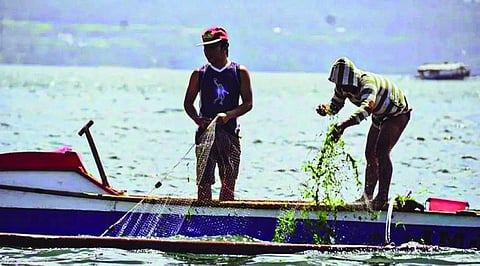

AFTER local fisherfolk and an ocean protection group said amendments to the Fisheries Code would include allowing commercial fishing inside municipal waters, an official from the Bureau of Fisheries and Aquatic Resources (BFAR) 7 confirmed that there are indeed proposals to reduce the coverage of the municipal waters but said the proposals were not seen to harm small fishermen's interests.
Allan Poquita, director of BFAR 7, said they are proposing to minimize the length of the municipal waters to increase fish production.
Poquita welcomed President Marcos Jr.'s vow to revise Republic Act (RA) 10654, which amended RA 8550, "The Philippine Fisheries Code of 1998," also because the amendments, he said, would include provisions that would pave the way for the creation of a department that will be solely dedicated to looking after the fisheries sector in the country.
Marcos mentioned his intention to amend the Fisheries Code during his Second State of the Nation Address (Sona) on July 24, 2023.
Municipal waters
Municipal waters are bodies of water within the jurisdiction of a municipality. They include inland waters such as streams, lakes and ponds, as well as marine waters that are within 15 kilometers of the coastline.
Poquita confirmed that they are pushing for changes in the measurement of the municipal waters around the country.
"It is one of the amendments, but it will not remove the municipal waters. But to reduce it, for example, from 15 kilometers it will become 10 kilometers or whatever will be decided," he told SunStar Cebu last Monday, July 31.
Only small-scale or municipal fisherfolk are currently allowed to fish in municipal waters. As a general rule, only municipal fishing boats weighing less than three gross tons are allowed.
However, Section 18 of RA 8550 allows the municipal or city government to authorize or permit small and medium commercial fishing vessels to operate within the 10.1 to 15-kilometer area from the shoreline in municipal waters if certain conditions are met, such as that the area must be at least seven fathoms deep, fishing methods and gear are consistent with Department of Agriculture (DA) national policies, and prior consultation with the Municipal or City Fisheries and Aquatic Resources Management Council is conducted, among other conditions.
Poquita said this proposal is being pushed by the National Government because municipal fisherfolk do not go to the farthest portion of the municipal waters anyway, so a portion is not utilized.
He said the plan will still undergo consultations with the local fishing sector, especially the municipal fisherfolk.
Decline
Last June 26, in response to Marcos' Sona, Oceana Philippines acting vice president Rose-Liza Eisma-Osorio had raised the alarm against his plans to amend the Fisheries Code, saying subsistence fisherfolk cannot compete with industrial fishers, so making revisions within the municipal waters means the fish stocks or resources will decline.
The fisherfolk group Pambansang Lakas ng Kilusang Mamamalakaya ng Pilipinas (Pamalakaya) also expressed fears that changes might be implemented within the municipal waters intended for small-scale fisherfolk.
"There can be no 'harmonization' between the municipal fishers and commercial fishing vessels," Pamalakaya said in a statement on Tuesday, July 25.
They also said industrial fishermen outperform traditional fishermen and that their large fishing vessels can fully utilize the fisheries and marine resources in a limited number of fishing operations, thanks to their sophisticated, if not destructive, fishing gear.
Own department
On the creation of a fisheries department, Poquita said this would be a welcome development as the Philippines is the only Asian country that does not have a fisheries department.
As a mere bureau, BFAR, an attached agency of the DA, has less resources than departmentalized sector agencies.
"I hope it [Fisheries Code] will be deepened so that it will create BFAR and transform it into a department. So far, we are the only country, not only in Southeast Asia but the only Asian country, where the fisheries agency is still a bureau, not a department," he said.
The bureau is responsible for the development, improvement, management and conservation of the country's fisheries and aquatic resources. It was reconstituted as a line bureau (from merely a staff bureau) by RA 8550.
RA 10654, which amended RA 8550, gave the law provisions to prevent, deter and eliminate illegal, unreported and unregulated fishing.
Interests
During his Sona, Marcos urged Congress to support his plan to revise the Fisheries Code to "protect both the interests of our fisherfolk and our fisheries and aquatic resources."
Poquita said the amendments will bolster the development of the fishing sector in the country, a priority of the President as agriculture secretary.
In particular, Poquita said making the bureau a department will give the agency power to enable more projects, particularly those that will increase fish production, unlike now when he said that among the attached agencies and corporations under the DA, BFAR receives the lowest budget.
The director did not say how much the BFAR's budget was.
"For example, during [super typhoon] Odette [in December 2021], among the most affected were the local fisherfolk. But of all the quick response funds of the DA, Fisheries got the lowest," he said, adding that it will also give power to fisheries officials in terms of decision-making.
Hatcheries
The regional director said Marcos also intends to maximize the potential of legislated hatcheries that will be built in different areas in the country, which "could help fish production."
Legislated hatcheries produce larval and juvenile fish, shellfish and crustaceans, primarily to support the aquaculture industry where they are transferred to on-growing systems, such as fish farms, to reach harvest size.
Poquita said that in Cebu Province alone, three legislated hatcheries will be built.
He said the construction of the legislated hatchery in Bantayan town in northern Cebu has just started and is currently at five percent of construction.
The other legislated hatcheries will be built in Moalboal and Argao towns in southern Cebu, but he did not specify when they will be started.
According to the Philippine Statistics Office, fisheries accounted for 12.7 percent or around P54.32 billion of the total value of agricultural production in the first quarter of 2023, which was P428.69 billion. (with CTL)
