

* Metro Cebu’s air quality reached a “very unhealthy” PM2.5 AQI of 180 in Talisay City on Sunday, Oct. 11, 2026, driven by vehicle emissions, industrial operations, and atmospheric trapping.
* EMB 7 ruled out Indonesian forest fire pollution and warned high particulate levels may persist, while Pagasa projected ITCZ-driven rains starting Oct. 12 could help disperse air pollutants.
* Health officials advised the public to limit outdoor activities and wear N95 or KN95 masks, while urging local governments to enforce stricter emission and fire prevention policies.
METRO Cebu’s air quality remained “very unhealthy” on Sunday, Oct. 11, 2026, with fine particulate matter levels rising through the day as local emissions and weather conditions continued to limit the dispersion of pollutants.
The Environmental Management Bureau (EMB) 7 warned that high concentrations of fine particulate matter (PM2.5) could persist in the coming days, although localized rain showers may help remove pollutants from the air.
Meanwhile, the Intertropical Convergence Zone (ITCZ) is expected to bring scattered rains and thunderstorms across most parts of the Visayas and Mindanao on Monday, Oct. 12, according to the Philippine Atmospheric, Geophysical and Astronomical Services Administration (Pagasa).
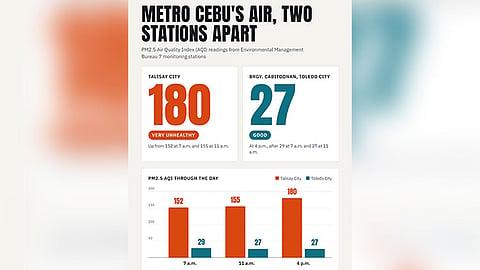
As for the air quality readings, the monitoring station in Talisay City recorded an Air Quality Index (AQI) of 180 for PM2.5 at 4 p.m. on Sunday, up from 152 at 7 a.m. and 155 at 11 a.m. The reading remained in the “very unhealthy” category.
In contrast, the monitoring station in Barangay Cabitoonan, Toledo City, recorded an AQI of 27 at 4 p.m., remaining in the “good” category after readings of 29 at 7 a.m. and 27 at 11 a.m.
EMB 7 attributed Metro Cebu’s poor air quality to local pollution sources, including vehicle emissions and industrial operations, compounded by unfavorable weather conditions.
The bureau said lower temperatures from nighttime to early morning can trap fine particulate matter near the ground and limit the dispersion of pollutants in the atmosphere.
Transboundary pollution
Environment officials have ruled out pollution from Indonesian forest fires as a factor in Metro Cebu’s current air quality, citing the end of the southwest monsoon, or habagat, and the strengthening of the high-pressure system over East Asia.
EMB 7 said no pattern of transboundary pollution from Indonesian wildfires had been observed so far.
Health advisory
The public is urged to limit outdoor activities and wear N95 or KN95 masks when outdoor exposure is necessary. People with heart or respiratory conditions are advised to remain indoors and seek medical attention when necessary.
EMB 7 also encouraged local government units to consider emission-reduction policies, greening initiatives and stricter enforcement against open burning of waste. It urged them to strengthen fire prevention and quick-response measures. / DPC