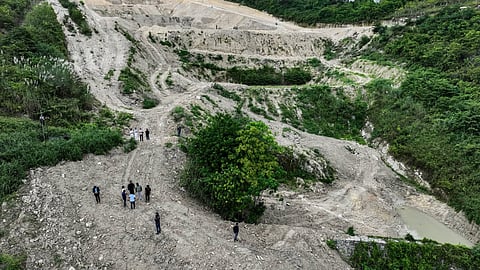


MONTERRAZAS de Cebu cannot be expected to withstand a single worst-case storm such as typhoon Ruping, its construction head said as the developer defended the capacity and design of its flood-control facilities.
Construction head Ranel Pelpinosas said the development's drainage design considers rainfall intensity, duration and frequency, as well as the property's terrain and the runoff expected from developed and undeveloped areas.
“For that, there is no drainage system that can withstand a single worst-case storm. Whether here or anywhere else, there really isn’t one that can withstand it,” Pelpinosas said during a media briefing and site tour on Tuesday, September 22, 2026.
“But what we have done is triple the requirement based on what is stated in the storm drainage standards in relation to our permits,” he added.
Detention ponds
The developer's explanation came amid renewed scrutiny of Monterrazas' flood-mitigation system after Cebu City Vice Mayor Tomas Osmeña questioned whether the development's detention ponds could handle extreme rainfall.
During the City Council's discussion of the Technical Infrastructure Committee (TIC) report on September 15, Osmeña cited 271 millimeters of rainfall during Typhoon Ruping and presented his own calculation that rainfall of that magnitude over the approximately 118-hectare property could generate more than 300,000 cubic meters of water.
Historical technical references, however, place the highest one-day rainfall recorded at Mactan during Typhoon Ruping in November 1990 at 276.1 millimeters.
Osmeña said that if detention ponds were to be used, their capacity should be increased to about 300,000 cubic meters and the ponds should have a drainage system that would allow stored water to be pumped out.
The more than 300,000-cubic-meter figure was Osmeña's own calculation presented during the council discussion and was not adopted by the council as a technical finding. Recent reporting said the council returned the TIC report to the committee for further technical review, including questions about the engineering basis of the required detention capacity and the design storm used.
During Tuesday's site tour, the developer showed the media the detention system serving Catchment 01, a roughly 20-hectare area within the development.
The catchment has seven detention ponds with a combined capacity of 27,483 cubic meters, according to the developer. The required capacity for the catchment under the project's design is 8,220 cubic meters.
That gives the catchment more than three times its stated detention requirement.
Pelpinosas said the ponds are not intended to function as one large basin receiving runoff from the entire 118-hectare Monterrazas property.
Instead, the development is divided into catchment areas based on the terrain and natural drainage paths, with detention facilities assigned to individual areas.
In Catchment 01, the upper detention pond first collects runoff from its immediate area. If the pond reaches capacity, water is designed to flow toward the succeeding pond, continuing through the series until it reaches the final pond.
The final pond is located beside a neighboring subdivision.
Pelpinosas said that even if the ponds become overwhelmed, the discharge from the final pond is controlled.
The system is intended to temporarily store stormwater and reduce the rate of peak flow moving downhill rather than allow runoff to rush directly toward lower-lying areas.
Dewatering and monitoring
Monterrazas general manager Marie Camille Bondad said the company also dewaters the detention ponds after rainfall to restore available storage capacity.
The release is gradual through a storm pump, with the discharge passing through a three-inch pipe, according to the developers.
For the upper ponds, water is released within the development, while the final pond directs its discharge toward the public drainage system in a controlled manner.
Bondad said the practice allows the ponds to regain storage capacity before another rainfall event.
The developer also cited its monitoring of recent heavy rains.
Bondad said that after Typhoon Tino, the water level in the detention ponds was about a meter from the bottom and there had been no discharge.
She also cited the heavy rainfall on July 30, saying there was no discharge from the Monterrazas detention system even though neighboring areas experienced flooding. A July 31 report by SunStar, citing the developer's progress report, said the company reported 22.2 millimeters of rainfall that day and zero discharge from the detention ponds as of 4:22 p.m.
The company operates two weather stations within the development, which the developers said are accredited by the Philippine Atmospheric, Geophysical and Astronomical Services Administration (Pagasa).
Rainfall information from the stations is reported to government agencies, including the Environmental Management Bureau, as well as the city and barangay governments, the developers said.
Pelpinosas said the drainage design also considers the storm's return period, which refers to the statistical probability of a rainfall event of a particular magnitude occurring in a given year.
For Monterrazas, he said the design considers a 50-year return period.
The developers also said the design considers the runoff coefficient, or the portion of rainfall expected to become surface runoff.
Pelpinosas said roads and other hard surfaces generate different runoff characteristics from areas that remain covered by grass or vegetation.
The distinction is relevant to the 118-hectare property, where not all areas have been developed.
Development and review
The developer said about 53 hectares of the property have been completed.
Another roughly 28 hectares are currently undergoing development, including the 25-hectare Montelago project, which is being developed in segments, and a three-hectare Rise project.
About 37 hectares remain untouched or undeveloped, according to the developers.
Because those areas have not yet been developed, Bondad said they retain their existing ground cover and do not yet have detention ponds specifically serving future development areas.
Pelpinosas said additional detention facilities have already been considered for succeeding phases.
The 118-hectare development currently has 24 detention ponds in total, the developer said. Recent reports put their combined capacity at 62,710.5 cubic meters, compared with 26,701 cubic meters required under the approved drainage and flood-mitigation design.
The developers said the detention capacity and drainage plans were included in documents submitted to government agencies for approval.
Pelpinosas said the Cebu City Government reviews development plans, including proposed drainage layouts, before permits are issued.
The development also requires other permits for structures and subsequent construction activities, he said.
Construction progress is regularly reported to government agencies, with some reports submitted weekly and others monthly, the developers said.
They also said the environmental compliance certificate covers the overall development.
The briefing came a week after the Cebu City Council referred the TIC report on Monterrazas back to the committee for further review.
The TIC had recommended allowing existing and ongoing projects to continue, but councilors questioned the report's technical basis, including the project's detention capacity and the recommendation itself. The council ultimately returned the report to the committee to address the unresolved technical issues.
Pelpinosas said the company was prepared to cooperate with further inspections and provide additional technical information requested by the city.
The developer also welcomed the city's inspection of other developments following concerns over flooding.
Pelpinosas said Monterrazas should not be viewed as an isolated development because runoff eventually becomes part of a broader drainage and watershed system.
He said the company was willing to work with the government as it examines the contribution of different developments to flooding.
The developers said they had not yet met with Osmeña to discuss his concerns but were open to explaining the drainage system to him.
Bondad said the company understood why Monterrazas had become a focal point in the city's continuing flood discussion.
“We understand though why we are the focal point of this topic,” she said.
The City Council is awaiting the TIC's further review as questions remain over the adequacy of Monterrazas' flood-mitigation measures and how runoff from the development interacts with downstream drainage and communities. (CAV)