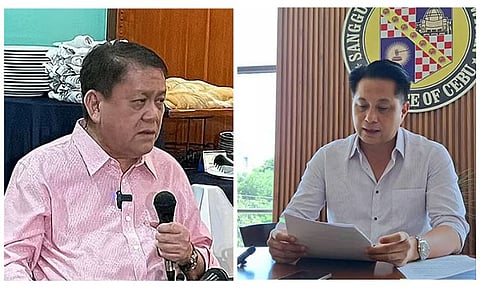


[] Confusion of roles sometimes results in VMs and vice guvs doing things expressly prohibited --- under the principle of separation of powers and checks and balances -- or in the gray area of legality.
“The vice mayor’s office is BOTH executive and legislative! Read the Local Government Code. The office is unique in that sense…. well (so is) the vice governor’s office…”
--- From FB post of former Cebu City administrator Nigel Paul Villarete, Oct. 30, 2026
The offices of the vice mayor and the vice governor are called a “hybrid” because their occupants perform dual-character role: both legislative and executive functions.
“Essentially executive by structural design yet assigned legislative functions.”
The vice mayor and vice governor are “chief executives-in-waiting” who take over as mayor or governor in cases of vacancy, absence, or temporary incapacity.
In their regular capacity, they sit as presiding officer of the local legislature: city council, municipal council, or provincial board. Yet they are not strictly members as they can’t file resolutions and ordinances and can’t relinquish the gavel to take part in the council or board debate, and can’t vote except in case of a tie.
BUT -- the huge but, the dual role notwithstanding -- they cannot perform both functions simultaneously or concurrently. “They cannot have their feet on both branches at the same time.”
The first legal obstacle is “absolute” principle of separation of powers with its twin the principle of checks and balances.
Which has led to the second legal barrier: prohibition on simultaneous performance of legislative and executive functions by the vice mayor or vice governor.
Under the old rules (Batas Pambansa Blg. 51 of 1983), the mayor presided over the council, thus exercising both executive and legislative powers.
The Local Government Code of 1991 changed that. The executive and legislative functions cannot be exercised by the vice mayor or vice governor at the same time. Wearing legislative shoes, he or she cannot do the mayor’s or governor’s job. Or in the mayor’s/guv’s shoes, he or she cannot preside over council or board sessions.
As the Supreme Court ruled in La Carlota City vs. Rojo (GR#181367, April 24, 2012), commenting on the Local Government Code or Republic Act 7160, there is a strict ban on intermingling powers.
Which jurisprudence, DILG or Department of Interior & Local Government, the agency that oversees local governments, uses to support its DILG Legal Opinion #40 series of 2025.
DILG, relying on the Supreme Court rulings, emphasizes that the union of executive-legislative powers “has been fully disbanded” and VMs and vice guvs as acting chief executives “cannot continue to simultaneously exercise the duties of their regular office or preside over legislative sessions.”
The government structure shows they’re serious about the separation of powers thing.
When a temporary vacancy occurs in the mayor’s or governor’s office, the powers of the VM, or the vice guv – who also automatically assumes the chief executive’s post – as Sanggunian presiding officer are “automatically suspended.”
DILG Legal Opinion #22 series 2012 is specific and clear on that.
[] They are structurally executive officials -- “executives in waiting” -- but assigned legislative duties, which are the regular day-to-day job of VMs and vice-guvs. The legislative work is restricted to presiding sessions and don’t include the work of regular members of the Council, such as sponsoring resolutions and ordinances and taking part in debates and committee work. While they are counted to determine quorum, they can vote only in case of a tie.
[] They cannot do both legislative and executive functions at the same time, except for the administrative supervision over the Council personnel.
Under existing rules, it will be difficult to explain a “night mayor,” with simultaneous functions in the legislative and executive.
Also hard to defend is the fact of councilors or board members doing executive department tasks. Some mayors and governors justify it thus: councilors or board members are doing oversight work -- to see to it that legislative agenda are carried out satisfactorily pursuant to resolution or ordinance.
A way out is that it is not official and just a “pretend” set-up (“mayor-mayor”), for public promotion and branding, incentive in team-building, or arrangement for coordination between the executive and legislative departments.
Regular councilors or board members cannot be formally appointed or designated to perform executive functions or tasks by the mayor or governor. The Constitution (Article IX-B and the Local Government Code prohibit that.
A local legislator “cannot handle an executive position where he/she ends up reviewing or auditing an executive project or budget that they themselves managed or implemented.” Forbidden dual role.
Mayors and governors may try to go around the rule on separation of powers/checks and balances rule by:
--- not making a legislator act like a department head but a kind of overseer, equivalent to the “little mayor” in charge of, say, public works or waste disposal;
--- vesting the lawmaker with the unofficial badge of mayor’s deputy or go-between (“Who’s he?” “The mayor’s guy.”)
--- making the councilor or board member “adviser” to the department;
--- not putting the legislator into the day-to-day operations of the department, but allowing to “coordinate,” which may include making major decisions.
The propensity of mayors or governors to involve legislators in executive tasks may go against the provisions on separation of powers and checks and balances.
Yet here’s the deal: the mayor is more likely allied with his/her vice mayor, and the governor with his vice governor. Thus, they can still coordinate on the work, even without actually dragging lawmakers to executive functions.
If they’re political rivals, it may benefit the LGU constituents if there’s some modus vivendi to keep public service going, including lawmakers doing executive work. There are boundaries of law and regulations that will stop them from going beyond.
Nobody has complained. Rival political party or persons are not bothered by the practice. No auditing procedure has been spotted by COA.
It is all right. Until it’s not.