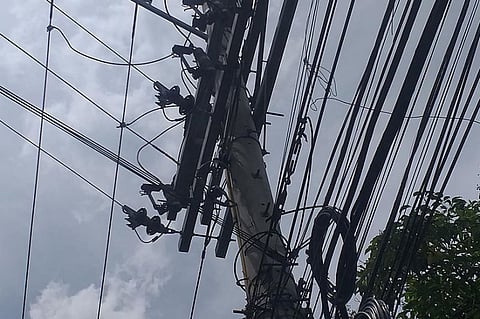


The Regional Development Council 7 asked the Office of the President, upon the recommendation of the Department of Energy, to declare a state of power emergency in Central Visayas to fast-track immediate measures and power projects.
The request follows months of tight supply conditions in the Visayas grid, which recorded more than 120 yellow and red alerts from January to September due to unavailable generating units, derated plants, and limited power imports.
Local and national actions to address the power situation include the Cebu Provincial Government's plan to offer solar-panel installation at barangay centers and House Resolution 1439 filed by Cebu Third District Rep. Karen Hope Garcia.
RECURRING power shortages and rotational brownouts in Central Visayas have prompted the Regional Development Council (RDC) 7 to seek a declation of a state of power emergency, which it said could speed up measures and projects to address the region’s electricity supply problem.
The RDC 7—composed of public and private stakeholders from Cebu and Bohol —made the request during its third-quarter full council meeting at Carcar City Hall on Wednesday, Sept. 30, according to a statement posted on the Cebu Provincial Government’s Facebook page on Thursday, Oct. 1.
The council, chaired by Gov. Pamela Baricuatro, asked the Office of the President, upon the recommendation of the Department of Energy, to declare a state of power emergency in Central Visayas.
RDC 7’s proposed declaration is intended to fast-track immediate measures and power projects, including the construction and expansion of generation facilities. The council also expects it to help accelerate priority transmission and substation projects of the National Grid Corp. of the Philippines (NGCP).
Months of power woes
The proposal comes after months of tight supply conditions in the Visayas grid. The grid was placed under yellow alert from 5 p.m. to 7 p.m. Monday, Sept. 28, with available capacity at 2,572 megawatts (MW) against projected peak demand of 2,374 MW.
For Tuesday, Sept. 29, NGCP reported 2,678 MW of available generating capacity against projected peak demand of 2,431 MW, leaving an operating margin of 247 MW.
The grid had recorded more than 120 yellow and red alerts from January to September, according to NGCP data cited in reports by the Philippine News Agency and other outlets. The alerts were linked to unavailable generating units, derated plants and limited power imports.
NGCP officials said several power plants now under preventive maintenance are expected to return to service by November, including the 169-MW Unit 1 of Therma Visayas Inc., the 103-MW unit of KEPCO SPC Power Corp. in Cebu, and the 150-MW Unit 3 of Panay Energy Development Corp. in Iloilo.
The grid operator said the return of the units could improve the power situation from mid-November through December, although it could not guarantee that rotational brownouts would end.
RDC 7 said the supply deficiency requires measures that address immediate electricity needs and longer-term generation and transmission requirements.
A similar appeal was made earlier by the Regional Development Council 6 in Western Visayas, which sought a state of power emergency covering the entire Visayas after a Sept. 14 meeting with Energy Secretary Sharon Garin. DOE data presented during the meeting showed a 415-MW supply deficit in the Visayas at the time.
Local, national actions
RDC 7 also discussed measures that local governments could pursue to help ease the energy situation.
One proposal is the Cebu Provincial Government’s plan to offer solar-panel installation at barangay centers as part of its services for barangay leaders.
An NGCP official said during a Mandaue City Council session on Sept. 30 that solar power accounts for nearly 35 percent of the Visayas’ supply but is available only during the day, making evening supply conditions tighter.
The power situation has also reached Congress. Cebu Third District Rep. Karen Hope Garcia filed House Resolution 1439 on Sept. 9 seeking an inquiry into recurring grid alerts and rotational brownouts affecting Cebu and the Visayas grid. The resolution seeks to examine generation unavailability, transmission capacity, infrastructure delivery and the effects on electricity rates, host communities and the provincial economy.
A joint House hearing on the resolution and other Visayas power measures is scheduled in Bacolod City on Saturday, Oct. 3.
Other projects
RDC 7 also advanced infrastructure initiatives involving flood control, transportation, ports and connectivity in Central Visayas.
Eight dam projects have been proposed in Cebu for 2027 to address flooding and water shortages. A 70-meter dam on the Mananga River has also been identified for inclusion in the 2027 National Expenditure Program.
RDC 7 is also pursuing an update of the Metro Cebu Integrated Flood Control and Drainage System Master Plan.
The Central Visayas Regional Development Investment Program includes the Consolacion-Liloan Bypass Road Project. RDC 7 endorsed the bypass road project to the Economy and Development Council-Investment Coordination Committee.
The RDC 7 Economic Development Committee endorsed the construction of the Manga Fish Port in Tagbilaran City, Bohol, during the committee’s third-quarter meeting on Aug. 28. / CDF