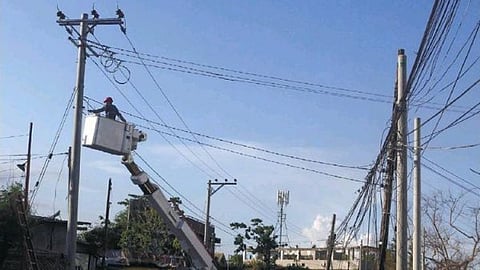


The Lapu-Lapu City Council convened with representatives from the NGCP, ERC, and Meco on Sept. 23, 2026, to address rotational brownouts caused by a severe regional power generation deficit.
Officials scrutinized rising monthly electricity bills driven by external generation, transmission, and ancillary service charges, leading the City Council to push for audits and detailed outage schedules.
Representative Junard “Ahong” Chan co-authored House Resolution 1430 to demand a congressional inquiry into regional ancillary service charges, power generation, and transmission projects.
LAPU-LAPU City officials are pressing national and local power agencies for solutions as consumers face a mounting dual burden: recurring rotational brownouts and rising electricity costs.
The Lapu-Lapu City Council convened on Wednesday, Sept. 23, 2026, to confront representatives from the National Grid Corp. of the Philippines (NGCP), the Energy Regulatory Commission (ERC) and the Mactan Electric Company (Meco). The discussions highlighted a severe lack of power supply across the Visayas region and the compounding charges that are ultimately passed down to local households and businesses.
Root of the supply crisis
The immediate cause of the rotational brownouts is a deficit in the region’s overall electricity production. The NGCP, which manages the transmission of electricity nationwide, attributed the grid interruptions to inadequate generation capacity and the unavailability of several power plants.
Because existing facilities cannot produce enough power to meet the daily demand in the Visayas, the grid operator must implement rotational outages to prevent a wider system collapse. Vice Mayor Celedonio “Celsi” Sitoy, who presided over the session, noted that NGCP officials could not provide a definite timeline for when these interruptions would cease.
“Ang kakuwang ra gyud sa generation power ang problema. Nagkinahanglan ta ug dako nga generation power,” Sitoy said.
(The problem is simply the lack of generation power. We need a large amount of generation power.)
Sitoy indicated that the power supply problem is unlikely to be resolved by November. He cited a lack of prospective investors willing to build the additional power plants required to stabilize the grid.
Breakdown of consumer charges
Beyond the lack of reliable electricity, officials also scrutinized the steady increase in consumers’ monthly bills. Meco, the local distribution utility, maintained that several components driving up the final cost are outside its direct control.
These external costs are divided into three main categories. Generation charges cover the actual cost of purchasing electricity from power producers. Transmission charges pay for the delivery of that electricity through the high-voltage grid operated by the NGCP. Finally, ancillary services are fees paid to maintain backup power reserves, which are necessary to support the reliability of the grid during supply fluctuations.
When the cost of generating or transmitting power increases, those expenses are automatically reflected in the monthly statements of Meco customers.
Local and national probes
Seeking relief for consumers, the Lapu-Lapu City Council has taken formal steps to audit these costs. Through Resolution 17-2233-2026, approved earlier in July, the council requested the Department of Energy and the ERC to thoroughly examine the generation, transmission, and other mandatory charges collected from Meco customers. The resolution also demanded a review of Meco’s power supply agreements and its internal billing and meter-reading procedures.
The council has also pushed for better communication regarding the outages. Through a separate measure, Resolution 17-2518-2026, officials urged Meco to issue highly specific schedules that identify affected areas and expected outage durations, allowing residents to better prepare.
The scrutiny extends to the national level. Lone District Rep. Junard “Ahong” Chan is among the principal authors of House Resolution 1430, which seeks a congressional inquiry into the ancillary service charges paid by electricity consumers in the Visayas. The measure questions the actual availability and delivery of the backup power reserves that consumers are paying for, while also calling for a broader review of regional energy storage, power generation, and transmission projects.
For now, local officials are focusing on immediate mitigation. Sitoy plans to coordinate with the mayor to develop localized measures to help residents cope with the continuing outages and high bills. Meanwhile, the City Council awaits a concrete action plan from the ERC to address the structural issues raised during the session. / DPC