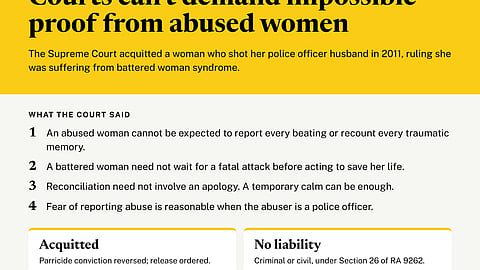


The Supreme Court acquitted a woman convicted of parricide for shooting her police officer husband in 2011, ruling she suffered from battered woman syndrome under Republic Act 9262.
The High Court reversed a 2023 Court of Appeals decision, ordering her release from the Correctional Institution for Women and exempting her from criminal and civil liabilities.
The Supreme Court criticized lower courts for demanding an impossible standard of proof, noting that fear of retaliation and distrust in law enforcement explain why abused women often do not report violence.
THE Supreme Court (SC) acquitted a woman who shot her husband, a police officer, in 2011, ruling that she was suffering from battered woman syndrome when she killed him.
The Second Division reversed a 2023 Court of Appeals (CA) decision that had upheld her conviction for parricide and her sentence of reclusion perpetua. It ordered her released from detention unless she is being held for another lawful cause. She had been confined at the Correctional Institution for Women in Mandaluyong City since Oct. 21, 2022.
It faulted the CA for demanding a kind of proof that abused women are seldom able to give.
“Courts must be careful not to demand an impossible standard of proof that is blind to the realities of abuse,” the SC said.
The High Court withheld the names of the woman, her husband and their relatives under confidentiality rules covering cases under Republic Act (RA) 9262, or the Anti-Violence Against Women and Their Children Act of 2004.
Battered woman defense
The SC recognized the syndrome in People v. Genosa in 2004. It described a cycle in which tension builds in a relationship, erupts in an acute beating and then gives way to a period of calm. Under the decision, a woman must show, among other things, that the cycle happened at least twice and that the last beating left her honestly convinced she had to use force to save her life.
RA 9262, passed the same year, went further. Section 26 says a woman found to be suffering from battered woman syndrome incurs no criminal or civil liability even when the elements of self-defense are missing.
In the new ruling, the High Court said the provision does not require a battered woman to wait for a fatal attack before acting to save her life.
Two cycles found
The SC traced two cycles of violence in the record, relying on the woman’s testimony, a medical certificate and the findings of a government psychiatrist.
The first began after her husband was reassigned and she heard he was seeing another woman. It peaked on Sept. 16, 2010, when she found him at a hotel with another woman, who attacked her while he held her back. The certificate, which listed hematomas on her forehead and left jaw and a cut on her left palm, was signed on Feb. 2, 2012, nearly a year after the shooting. The decision does not explain the gap.
She did not say he apologized. For the High Court, the fact that the couple stayed together was enough to mark the reconciliation phase.
“The ‘contrition or honeymoon phase’ need not involve grand gestures of remorse but may sometimes consist of merely a temporary calm between the couple,” the SC said.
Night of the shooting
The second cycle ended on Feb. 8, 2011. She testified that at about 6 p.m., her husband threw their two-year-old son onto a chair and she hit him on the head with a ladle.
Two hours later, as she packed to leave, she said he threatened that they would not get out of the house alive and slammed her head against a wall. She remembered nothing more until she woke up at the police station.
A sister-in-law testified that she later heard several gunshots from the couple’s house. When the door opened, she saw the woman holding a gun. The woman told her, “Mas gugustuhin ko nalang makulong, ‘te (I would rather be imprisoned).”
The arresting officer, a neighbor, testified that the woman said she had shot her husband by accident. According to the decision, the woman admitted in her testimony and appeal brief that she shot him with his own gun, saying the abuse she suffered led her to it.
The psychiatrist diagnosed her with major depressive disorder. A doctor who assisted in the evaluation testified that the depression began when the marriage turned abusive.
CA decision reversed
The CA had found her evidence insufficient. It said no relatives, neighbors or children backed her account and she produced no medical or police records showing a pattern of abuse.
However, the SC called that requirement misplaced.
“Studies have shown that women in abusive relationships are unwilling to report violent instances due to a numerous of reasons including social stigma, lack of trust on authorities, humiliation and cultural structures,” it said.
The woman, the SC said, did not go to the police because she feared retaliation and distrusted law enforcement.
“This becomes even more compelling where, as here, the alleged abuser occupied a position of authority as a police officer,” the SC said. “The accused’s fear of reporting abuse to law enforcement cannot be dismissed as unreasonable.”
The SC also found her exempt from civil liability. The CA had ordered her to pay her husband’s heirs P275,000 in damages. / KAL