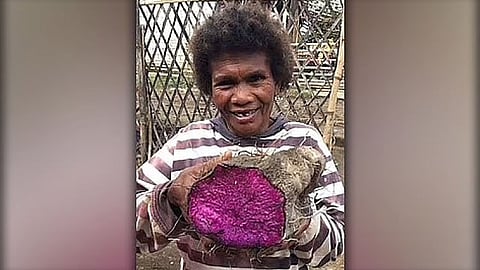

THE Philippines needs to strengthen its ube industry across the supply chain to capitalize on growing global demand for the purple yam and its processed products, according to a report by the University of Asia and the Pacific (UA&P).
The report, published in the university’s Center for Food and Agri Business (CFA) Briefer in September, said growing international interest in ube presents opportunities for Filipino farmers and processors. However, the industry’s ability to sustain export growth will depend on addressing persistent production constraints, improving product quality and developing a more coordinated supply chain.
Ube, or purple yam (Dioscorea alata), has gained international attention in recent years as Filipino restaurants, bakeries, and entrepreneurs introduced ube-flavored desserts and other products to overseas consumers. Often dubbed the “new matcha,” the crop has expanded beyond its traditional role in Filipino cuisine to become a sought-after flavor in international markets.
Despite the growing interest, Philippine ube production has declined even as exports have increased, highlighting a widening gap between overseas demand and the country’s ability to supply sufficient quantities of quality raw materials, the report said.
The Philippines recorded a trade surplus of $3 million in ube and ube products in 2025, with exports reaching about 1,700 metric tons valued at $3.1 million, according to the report. Shipments consisted of frozen ube and other forms of the crop, as well as purple yam jam and puree.
From 2021 to 2025, export volume grew by an average of 27.6 percent annually, while export value increased by 28.5 percent a year.
The United States accounted for 56.3 percent of total exports in 2025, followed by Canada, Australia, the United Kingdom and the Netherlands.
However, domestic production has struggled to keep pace with the growing market. The industry remains largely dependent on smallholder farmers, with the area planted to ube totaling 2,370 hectares in 2025.
Production reached about 12,500 metric tons that year, down from 14,000 metric tons in 2021, representing an average annual decline of about three percent, according to the report authored by Joy Kristel L. Orzales, senior agribusiness specialist at UA&P’s CFA.
Central Visayas accounted for about 33 percent of national production in 2025, followed by Calabarzon and Cagayan Valley.
The decline in output reflects both a reduction in harvested area and persistent productivity constraints, including shortages of planting materials and uncertain returns for farmers.
Average yield fell by about 2.3 percent annually, from 5.88 metric tons per hectare in 2021 to 5.27 metric tons per hectare in 2025. Yield dropped to a low of 4.69 metric tons per hectare in 2024 before recovering the following year.
Shortages in planting materials a major constraint
Limited access to quality planting materials has emerged as a major obstacle to expanding domestic production, the report said.
In September 2026, the Department of Agriculture (DA) announced the indefinite suspension of exports of fresh ube and propagative planting materials, a measure imposed by the Bureau of Plant Industry in mid-August.
The restriction is intended to retain planting materials in the country while domestic production capacity is strengthened.
Productivity is another concern.
The Department of Science and Technology has identified inconsistent production practices as a persistent constraint, while research in Bohol has highlighted the difficulty of producing ube year-round because harvested tubers naturally remain dormant for several months.
Maintaining consistent product quality is equally important as the industry expands its presence in international markets. Ube is sold both as a fresh commodity and in processed forms, and variations in quality can undermine export competitiveness and consumer confidence.
“The industry therefore needs clearer quality standards and more consistent practices from production through processing and handling,” the report said.
The industry also faces weaknesses in supply-chain coordination and market development. The DA has identified fragmented supply chains, inconsistent quality standards and the absence of a unified national marketing strategy as major bottlenecks.
Strengthening the industry will require coordinated
interventions, from producing sufficient quality planting materials and improving farm productivity to upgrading postharvest handling, expanding processing capacity and developing export markets.
“Moving beyond the current purple craze will depend on whether the Philippines can capitalize on the growing global demand and build a stronger and more sustainable domestic ube industry,” Orzales said.
“The way forward, therefore, is not simply to produce more ube. The industry needs to build the capacity to produce sufficient planting materials, raise farm productivity, maintain consistent quality, add value through processing, and coordinate the supply chain from farmers to international markets.” / PHILEXPORT
