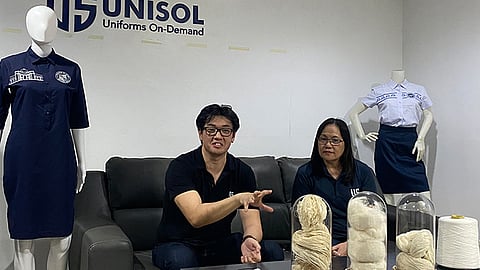


UNISOL, a Cebu-based uniform manufacturer, is leading efforts to help local government units (LGUs) comply with the Philippine Tropical Fabric Law (Republic Act 9242) through the launch of its Chameleon PS Collection for 2025.
The collection unveiled at Manila Fame 2024, features uniforms made from piña fabric sourced from various regions in the Philippines.
The initiative underscores Unisol’s commitment to sustainability and local craftsmanship. By pledging to use indigenous piña fabric for local government unit (LGU) employees, the company aligns itself with the law’s mandate to incorporate Filipino-made materials into government uniforms.
“At present, we are the only uniform company in the whole country offering such a product,” said Jonas Kee Quilantang, owner of Unisol.
Founded in 2017, Unisol set itself apart from the competition by rethinking the traditional uniform industry.
It aspires to become the go-to brand for uniforms akin to Jollibee’s dominance in the fast-food industry.
“That’s the vision, that we wanted to be the go-to brand because from the start there’s really no go-to brand for uniforms,” said Unisol’s sales head Leah Baltazar.
Unisol’s capacity to manage large-scale orders was put to the test when it successfully secured a government contract to produce 10 million face masks during the Covid-19 pandemic.
Chief operating officer Marcus Wong said that the company not only met the required target but exceeded it by producing more than twice the required volume.
“The shift from producing uniforms to manufacturing face masks at that time was driven by sheer determination,” he said.
Investment
Post-pandemic, the company invested in machinery to scale up operations and focus on uniform manufacturing. The firm employs about 200 workers.
Baltazar said the company’s breakthrough came when it secured contracts to supply uniforms for LGUs, a milestone that has propelled its growth. To date, Unisol is supplying government uniforms for LGUs in Cebu, Sibonga, Consolacion and Taguig and a few orders from the United Kingdom.
It is also eyeing to slowly penetrate the global market, supplying uniforms for small institutions in Australia, Singapore, the US and Canada, among others.
“Part of our expansion plans for 2025 is to go global. We are not just taking Unisol but the entire industry abroad,” said Wong.
To go global, Wong said the piña fabric would help them get a slice of the market, being both “highly sustainable and cost-efficient.”
“We want to show that it’s sustainable, economically viable and it can be mass-produced at volume. These three criteria are how we are going to take the global market,” said Wong.
He believes that the Philippine tropical fabric “could be the next Chinese silk.”
RA 9242 aims to support the local textile industry, encourage the use of indigenous raw materials and boost the livelihood of farmers and weavers in the Philippines. The law requires at least five percent of locally sourced tropical fabrics in government uniforms.
Despite challenges in raw material supply, Unisol remains steadfast in its mission to elevate the Philippine textile industry.
Unisol collaborates with cooperatives nationwide to ensure a steady supply of piña fabric. According to Wong, the most challenging aspect of this initiative lies in adapting the piña material to meet the company’s specific requirements for products like T-shirts, pants, jackets and other apparel.
To sustain its growth and ambitions, Wong said Unisol would seek support from the Department of Trade and Industry and other government agencies and forge partnerships with business chambers.
Besides expanding globally, and establishing itself as a key player in the international uniform market, Unisol aims to go public through an initial public offering by 2030 and professionalize its operations by obtaining ISO certifications, among others. / KOC