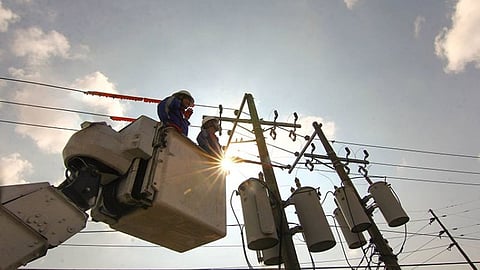


THE Visayas is emerging as a test case for an energy strategy combining dependable generation, renewable energy, battery storage, transmission investment and more efficient distribution, as businesses push for urgent action on electricity costs and reliability.
The need for a stronger power system was underscored Tuesday, Sept. 15, 2026, when the Visayas grid faced a 140-megawatt (MW) supply shortfall during peak hours, prompting the National Grid Corp. of the Philippines (NGCP) to issue red and yellow alerts.
NGCP said available capacity stood at 2,352 MW against projected peak demand of 2,492 MW. A red alert was declared from 5 p.m. to 7 p.m., while yellow alerts were issued from 3 p.m. to 5 p.m. and 7 p.m. to 8 p.m.
The grid operator attributed the shortfall to the unavailability of large coal-fired power plants TVI 1, TVI 2 and PEDC 3, as well as limited power imports from Mindanao.
Twelve power plants were on forced outage and 15 others were operating at reduced capacity, resulting in 962.9 MW of unavailable capacity.
The situation was an improvement from Monday, when the grid faced a 309-MW shortfall, with 2,153 MW available against peak demand of 2,462 MW.
The latest supply constraints reinforce concerns raised by the Cebu Chamber of Commerce and Industry (CCCI), which said the region’s ability to attract investment and create jobs increasingly depends on reliable and competitively priced electricity.
“The business sector cannot build a more competitive Cebu economy on an unreliable power supply,” CCCI president Regan King said.
Call for coordinated action
The chamber called for coordinated action by government, energy companies and other stakeholders to strengthen the Visayas power system, improve reliability and stabilize electricity costs.
“MSMEs and the workers and families who depend on them cannot afford to simply absorb the cost of a problem they did not create,” CCCI said.
Central Visayas’ economic expansion makes the issue more pressing. The region generated about P1.32 trillion in economic output in 2025, making it the largest regional economy outside Metro Manila, while growing 3.7 percent.
The Philippines recorded an average electricity rate of P12.43 per kilowatt-hour in June, the highest in Southeast Asia based on figures cited in the report. In the Visayas, supply constraints, forced outages and tight reserves have shown how reliability problems can quickly translate into higher costs.
For businesses, the concern is not only the level of electricity rates but also their predictability. Volatile power costs can squeeze operating margins and weaken the competitiveness of companies competing with firms in areas with cheaper or more reliable electricity.
Investments underway
The Visayas is seeing investments across several parts of the power system.
In Cebu, AboitizPower has a 60-MW battery energy storage system in the City of Naga, while Meralco PowerGen Corp. has energized the first phase of its Toledo battery storage project.
Renewable energy capacity is also expanding. Citing Department of Energy (DOE) data as of May, the Philippine Information Agency reported 2,179.47 MW of committed renewable energy capacity in the Visayas, covering biomass, geothermal, hydropower, solar and wind. It also cited 419.9 MW of committed energy storage capacity.
Transmission investment is proceeding alongside new generation. NGCP is developing the Cebu-Lapu-Lapu 230-kilovolt transmission line and Lapu-Lapu substation to support demand in Metro Cebu and Mactan Island and accommodate additional renewable capacity.
But adding generation alone will not solve the problem.
Efficiency critical
Electricity prices have also drawn scrutiny over system-loss charges amid proposals to amend the Electric Power Industry Reform Act and remove the charges from consumer bills.
Energy Secretary Sharon Garin has said consumer protection must be balanced with the reliability and long-term sustainability of the power sector.
The DOE has formed a task force with the Energy Regulatory Commission, National Electrification Administration and electric cooperatives to study the possible removal of system-loss charges and the corresponding value-added tax.
Changing how system losses are charged to consumers, however, would not eliminate the physical losses occurring within transmission and distribution networks.
Reducing those losses requires investments in lines, substations, transformers, metering and network management.
For Cebu businesses, the broader energy transition must focus not only on adding megawatts but ensuring those megawatts reach consumers efficiently and reliably.
Reliable and competitively priced electricity is ultimately an economic issue, affecting investment, employment and the region’s ability to sustain growth.
The success of the transition will not be measured simply by how much generating capacity is added, but by how effectively electricity reaches businesses and households when it is needed. / KOC