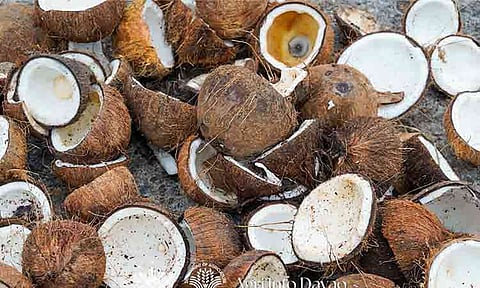

A COCONUT shell could soon become more than farm waste as the Department of Agriculture-Davao Region explores a potential market that could turn the by-product into an additional income source for coconut farmers.
Through its Agribusiness and Marketing Assistance Division, DA-Davao recently met with representatives of Borneo New Energy Company to assess the region’s supply of coconut shells and other coconut by-products for possible energy production.
Borneo New Energy representatives Lian Sheng Wang and Kiing Teck Wee discussed with DA-Davao officials the volume of coconut shells that farmers and cooperatives could collect, consolidate, and supply to the company.
The company has expressed interest in buying coconut shells as an alternative energy resource and is assessing whether Davao Region can meet its supply requirements.
An initial proposal calls for about 100 metric tons of coconut shells, although DA-Davao said the target remains subject to further assessment of available supply.
The agency is coordinating with the Katipunan Small Coconut Farmers Multipurpose Cooperative in Katipunan, Panabo City, Davao del Norte, as part of the assessment.
The cooperative has about 2,350 hectares planted with coconut and about 800 farmer-members. It produces an estimated 400 to 500 metric tons of coconut each month, giving it potential to contribute to the proposed supply chain.
But the volume of coconut shells that can actually be recovered from the cooperative’s production still needs to be determined.
DA-Davao also needs to assess whether the shells can be collected, consolidated, and transported in sufficient volume and at a cost that would support a sustainable supply arrangement.
From waste to value
The initiative highlights the growing potential of agricultural by-products that are often discarded or sold for little value.
For coconut farmers, a commercial market for shells could provide another way to earn from their harvest while helping reduce agricultural waste.
The proposed market linkage also supports DA-Davao’s push to connect farmers’ organizations with private-sector buyers and develop markets for locally produced commodities.
The discussions with Borneo New Energy stemmed from the Sabah International Expo 2026, where Philippine agricultural commodities were introduced to international and private-sector buyers.
DA-Davao said the expo opened discussions on potential commercial partnerships involving agricultural products and by-products from the region.
Through AMAD, the agency is continuing to facilitate talks between farmers’ groups and prospective buyers while assessing opportunities to add value to commodities produced in Davao Region.
For coconut farmers, the opportunity could extend beyond the nut itself.
If the supply assessment proves viable, coconut shells that might otherwise be discarded or sold at low prices could enter an emerging energy market.
For now, DA-Davao said the proposed partnership remains under assessment, with the region’s available volume and capacity to sustain deliveries still being determined.
The agency will continue working with coconut-producing groups and potential buyers to determine whether Davao Region can build a reliable supply chain for the proposed energy market. DEF
