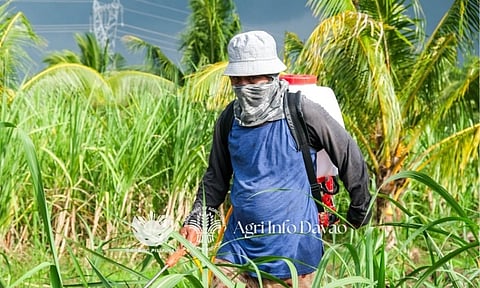


THE Department of Agriculture in Davao Region (DA-Davao) urges farmers whose crops are hit by El Niño to report the damage to their municipal agriculture offices immediately and leave damaged crops in the field until they are assessed.
DA-Davao Regional Executive Director Macario Gonzaga gave the reminder on Saturday, October 31, 2026, during an episode of the agency's Estorya sa Kaumahan program.
"Importante nga dili dayon ilisan o limpiyuhan ang tanang nadaot nga pananom sa dili pa ang kinahanglang assessment aron mapadali ang validation," he said.
(It is important not to immediately replace or clear all damaged crops before the required assessment, so validation can be faster.)
He said farmers with crop insurance should coordinate at once with the Philippine Crop Insurance Corporation (PCIC) and their municipal agriculture office (MAO) to start their claims. They usually need their insurance policy or proof of coverage, information on their farm and crops, and evidence of the damage. He added that the PCIC should confirm the exact requirements and deadlines.
He also cautioned that an insurance payout is not the same as other government aid.
"Ang PCIC indemnity lahi sa ubang government assistance, busa dili nato ikapasalig ang cash assistance kung wala pa kini opisyal nga naaprubahan," he said.
(PCIC indemnity is separate from other government assistance, so we cannot promise cash assistance unless it has been officially approved.)
He said emergency financial assistance may be available to qualified farmers, depending on program guidelines, eligibility, and available funds.
Report early
Gonzaga said a common problem is that farmers report only after losing their crops.
"Atong gidasig ang mga mag-uuma nga mosumbong dayon sa ilang mga MAO kung adunay timailhan sa moisture stress, ayaw huwata nga hingpit nang malaya o wala nay maani," he said.
(We urge farmers to report right away to their MAOs, and if there are signs of moisture stress, don't wait until the crops have fully withered or there is nothing left to harvest.)
He explained that reports start at the MAO. There, an agriculture technician and local officials inspect the farm and log the damage in DA's Disaster Risk Reduction and Management Information System. The municipality then uploads the report to the Provincial Agriculture Office, which coordinates with DA-Davao for validation.
He said reports should include photos, the damage location, the crop's growth stage, the affected area, and the estimated loss. Damage must be validated before it can be used as a basis for assistance. Standing crop reports are also updated every 15 days.
P584 million in losses
Citing the latest report of DA-Davao's disaster risk reduction and management and field operations teams, Gonzaga said El Niño damage since June 2026, which he counted separately from earlier moisture stress episodes, has affected 6,205 farmers.
"Lahi pa ang El Niño damage sugod June 2026 hangtod karon, nga naa nay 6,205 farmers ang apektado ug nikabat sa 584 million ang kantidad sa mao ang kadaot," he said, adding that reports from local government units are still being updated and validated.
(That is aside from the El Niño damage from June 2026 until now, with 6,205 farmers affected and the damage reaching 584 million.)
SunStar earlier reported that DA-Davao placed losses at P584.68 million across 6,634 hectares, based on figures presented at the Davao Peace and Security Press Corps briefing on Wednesday, Oct. 28, 2026.
Based on earlier moisture stress reports, DA-Davao is monitoring Davao del Sur, Davao City, Davao del Norte, and Davao de Oro.
"Sa Davao del Sur, sa Matanao ug Bansalan, lakip sa mga lugar nga ni-report ang grabeng naapektuhan sa kakulang sa tubig," he said.
(In Davao del Sur, Matanao and Bansalan are among the areas reported as badly affected by water shortage.)
He said bananas and other fruits have also been damaged. Farms that rely only on rain or have little irrigation, water-sensitive high-value crops, and areas with limited water for livestock also need close watch.
Worse drought ahead
Gonzaga said DA-Davao's El Niño action plan carries an estimated P729 million for preparation and mitigation. This includes P678 million to raise production in less vulnerable areas, P40 million for preparatory activities, and P9.9 million to save production in vulnerable areas.
"So, mag-andam pa ta kay dili lang karon pa, naa pa'y mas grabeng moabot nga hulaw," he said.
(So we have to prepare more, because it's not just now; a worse drought is still coming.)
He said DA-Davao is procuring quality seeds and encouraging rice and corn varieties that suit local conditions and withstand moisture stress. It is also providing organic fertilizers, bio-fertilizers, and soil conditioners. Farmers should choose varieties based on the advice of agricultural technicians.
The agency is also coordinating with the National Irrigation Administration (NIA) and local governments on the condition of dams and irrigation systems. They may use water pumps or solar-powered irrigation where suitable.
On cloud seeding, he said it is possible but depends on cloud conditions. Pump deployment and cloud seeding sites must first be confirmed by the Bureau of Soils and Water Management, NIA, Pagasa, and other agencies.
"Dili nato ipasalig ang usa ka operasyon hangtod kini opisyal nga nakumpirma," he said.
(We will not promise an operation until it is officially confirmed.)
He advised livestock raisers to make sure their animals have enough water, shade, and ventilation, and urged farmers to follow DOST-Pagasa advisories and diversify their crops.
"Andam daan, pagplano daan ug pangayo dayon ug tabang," he said.
(Prepare early, plan early, and ask for help right away.)
Pagasa has warned that El Niño is expected to intensify into a very strong one and persist through the first half of 2027. GRS
