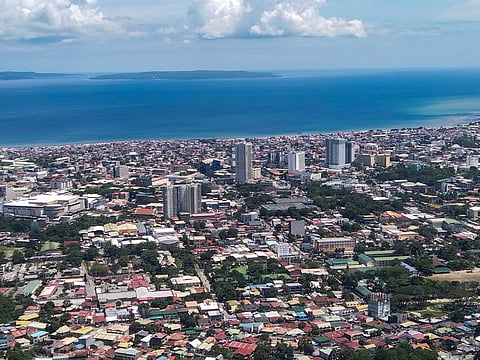

DAVAO City has climbed 49 places to 470th among the world’s 1,000 largest cities, moving from fifth to third among Philippine cities in the latest Oxford Economics Global Cities Index.
The city’s strongest showing came in environment, where it ranked 299th globally, well ahead of its rankings in economics, human capital, quality of life and governance.
Davao posted an overall score of 42.6, with category scores of 41.3 for economics, 40.1 for human capital, 48.3 for quality of life, 71.6 for environment and 52.9 for governance.
The jump puts Davao ahead of Cebu City, which ranked 474th, and behind only Manila at 174th and Angeles City at 388th among the nine Philippine cities included in the 2026 index.
A year earlier, Davao ranked 519th globally and fifth in the Philippines, behind Manila, Cebu, Angeles City and Bacolod. The 2025 index also placed Davao 258th in environment, its strongest category that year.
The latest result therefore represents a 49-place improvement globally and a two-place rise nationally.

What No. 470 means for Davao
The 470th-place ranking is not simply a measure of the size of Davao’s economy or a conventional livability ranking.
Oxford Economics assesses cities across five dimensions — economics, human capital, quality of life, environment and governance — to produce a broader picture of their strengths, weaknesses and future potential.
The research firm describes the index as a “holistic assessment” of the world’s 1,000 largest cities. It combines a range of socioeconomic indicators and its own city forecasts to assess both a city's current standing and its direction of travel.
That gives Davao's latest result a more nuanced meaning.
Its environment ranking of 299th is its strongest category in 2026, while it ranked 424th in economics, 464th in human capital, 623rd in quality of life, and 583rd in governance.
The figures show that Davao's overall position reflects a combination of strengths rather than dominance in any single economic measure.
Davao edges closer to Cebu
Davao's rise is particularly notable in its comparison with Cebu, which was the Philippines' second-ranked city in 2025.
Cebu ranked 373rd in Economics, 442nd in Human Capital, 670th in Quality of Life, 437th in Environment, and 583rd in Governance in the 2026 index.
Davao, meanwhile, ranked lower than Cebu in Economics and Human Capital but higher in Quality of Life and substantially higher in Environment.
The two cities are now separated by just four places globally.
The latest Philippine rankings place Manila first at No. 174 globally, followed by Angeles City at No. 388 and Davao City at No. 470.
Cebu City ranked fourth at No. 474, just four places behind Davao, while Bacolod came in fifth at No. 504. Cagayan de Oro ranked sixth at No. 530, followed by Dagupan at No. 620, General Santos at No. 818, and Zamboanga City at No. 823.
In 2025, the order was Manila, Cebu, Angeles, Bacolod, and Davao, followed by Cagayan de Oro, Dagupan, General Santos, and Zamboanga.
Manila remains far ahead
Manila retained its position as the Philippines' highest-ranked city, although its global ranking moved from 206th in 2025 to 174th in 2026.
In 2025, Manila ranked particularly strongly in human capital at 93rd and environment at 30th.
Angeles City ranked second among Philippine cities at No. 388 globally in 2026.
Davao's movement from No. 519 to No. 470 places it 296 positions behind Manila but only four positions behind Cebu, illustrating the relatively narrow gap between the two major Philippine urban centers in the latest index.
Davao among Asia's emerging cities
Oxford Economics classifies Davao among “Emerging Standouts,” a group of developing-world cities that are outperforming their respective countries and attracting residents through faster productivity growth and higher income levels.
Davao is explicitly listed by Oxford Economics as an example of an Emerging Standout.
The classification also puts the city in the context of a broader shift in global urban growth toward Asia.
“Major cities across Asia are currently dominating global growth trends,” Oxford Economics said in its 2026 findings, pointing to Chinese and Indian cities as major drivers of future growth.
The firm expects the shift to continue, with Shanghai, Beijing and Delhi projected to record some of the largest increases in GDP through 2050 despite currently ranking outside the global top 100. Oxford Economics also projects that the combined share of GDP from Chinese and Indian cities in its major-city dataset will exceed Europe's share by 2050.
In Southeast Asia, Singapore ranks 29th globally, while Kuala Lumpur is among the cities Oxford Economics has identified as a city to watch in 2026. Ho Chi Minh City is also classified as a city to watch.
The global top 10
The 2026 index remains dominated by North American and European cities.
The global top 10 are:
New York, United States
London, United Kingdom
Paris, France
Seattle, United States
San Francisco, United States
Dublin, Ireland
Boston, United States
San Jose, United States
Tokyo, Japan
Zurich, Switzerland
Oxford Economics said 78 of the top 100 cities are in Europe and North America, reflecting the continued strength of established urban centers in those regions.
New York and London retained the top two positions, with Oxford Economics attributing their continued strength largely to the size of their economies and the strength of their labor markets. Paris remained third.
Five measures, one city score
Oxford Economics weights five categories to calculate each city’s overall score: economics, 30 percent; human capital, 25 percent; quality of life, 25 percent; environment, 10 percent; and governance, 10 percent.
The economics category examines economic size, structure, and growth potential. Human capital measures talent, skills, and labor-force strength. Quality of Life covers well-being, livability, and access to amenities. Environment looks at environmental quality and sustainability, while Governance measures institutional strength and civic effectiveness.
Each category is indexed from 0 to 100, with the highest-performing city in the dataset receiving 100. The five category scores are then combined into one overall score.
Oxford Economics says the index is designed to provide a “data-driven, forward-looking view” of cities' relative strengths, weaknesses and future potential rather than simply rank them by economic size.
A stronger position, but a wider story
For Davao, the 2026 ranking tells two stories at once.
The first is the city's rise: from 519th to 470th globally and from fifth to third nationally in a single edition of the index.
The second is the city's profile: its strongest performance comes from environment, while its economics, human capital and quality of life rankings remain considerably farther down the global table.
That distinction matters because Oxford Economics says the strongest global cities tend to perform well across several categories, creating a reinforcing cycle in which economic strength helps attract talent and businesses, while strong human capital and quality of life support further growth.
For Davao, No. 470 is therefore less a finish line than a snapshot of a city gaining ground — one whose environmental standing is a clear strength, whose overall global position has improved significantly, and whose next challenge is to translate. MLSA