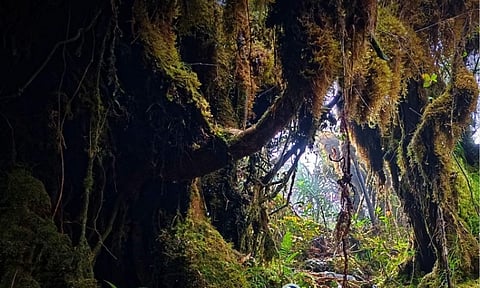


THE Department of Environment and Natural Resources (DENR) has opened some 144,000 hectares of forest land in the Davao Region to private investors, part of about 500,000 hectares across Mindanao now available for agroforestry, tree plantations, and renewable energy projects.
DENR Undersecretary for Field Operations-Mindanao, Joselin Marcus Fragada, presented the figures during the second day of the Mindanao Development Forum 2026, organized by the Mindanao Development Authority (MinDA), at Dusit Thani Davao on Wednesday, Oct. 28, 2026. He spoke on behalf of Environment Secretary Juan Miguel Cuna.
Based on his presentation, the DENR's Forest Management Bureau has delineated 500,011 hectares in 2,451 parcels across Mindanao. These are production forests outside protected areas, critical watersheds, and existing tenures.
The Davao Region accounts for 144,035 hectares, or 28.8 percent of the total, but has the most parcels at 1,195, nearly half of the 2,451.
Caraga has the largest area at 177,201 hectares, followed by Soccsksargen at 105,124 hectares, Zamboanga Peninsula at 39,130 hectares, and Northern Mindanao at 34,522 hectares.
Fragada stressed that the lands on offer exclude the island's remaining natural forests.
"These are not pristine old-growth forests. Our protection forests, our high-elevation watersheds, and critical protected areas remain strictly off-limits and conserved," he said.
"These 500,000 hectares are open, brush, and production forest lands ready for capital injection," he added.
Of the total, 272,057 hectares are set for agroforestry such as cacao, coffee, and rubber, 216,081 hectares for tree plantations for timber, wood processing, and biomass, and 11,873 hectares for pasture and ecotourism.
Working with the Department of Energy, the DENR also identified 132,896 hectares in 431 parcels that qualify for utility-scale solar and wind projects. Fragada said these sites lie within 20 kilometers of National Grid Corporation of the Philippines substations, on slopes below 20 percent.
One permit, set fees
The Sustainable Forest Land Management Agreement (SFLMA) will cover the areas, established under DENR Administrative Order (DAO) 2025-22 and later amended.
Fragada said the SFLMA replaces the older tenure instruments, such as community-based forest management agreements and the Integrated Forest Management Agreement, with a single agreement to make it easier for local governments and private firms to deal with the DENR.
Applicants submit a letter of intent, SEC or CDA registration, GIS maps of the area, and proof of funds, and pay a flat P10,000 application fee, according to his presentation.
Plantations and agroforestry pay 3 percent of gross revenue; pasture, P200 per hectare; renewable energy, P7,200 per hectare per year with a 10 percent annual increase; and ecotourism, P85,000 per hectare. Protection forestry pays nothing.
"Our fee structure is transparent: a 3 percent gross revenue share for timber and agroforestry, predictable annual rates for energy, and zero users' fee if you invest in protection forest restoration," Fragada said.
"We need the private sector to be involved; we need institutions to come in for us to have better programs in our timberland and forest land areas," he said.
Minerals
Fragada also pitched Executive Order 122, the critical minerals framework signed by President Ferdinand Marcos Jr. in August 2026, which designates critical mineral processing as national priority projects and pushes for smelting and refining in the country.
He said more than half of the over 74 mineral production sharing agreements issued by the DENR are in Mindanao, many of them in Caraga.
"The nickel-cobalt laterites of Caraga and the world-class copper deposits across Mindanao must not leave our shores in raw barges," he said.
His presentation noted that Philippine copper output reached 231,885 dry metric tons worth P26.63 billion in 2025.
His presentation also listed the enforcement of the Mining Industry Coordinating Council's environmental, social, and governance (ESG) standards and compliance with free, prior, and informed consent (FPIC) rules.
"Any enterprise operating in Mindanao must uplift indigenous communities, secure uncompromised social licenses, and restore the land better than they found it," Fragada said.
The DENR directed interested investors to the Forest Management Bureau's forest investment portal. GRS
