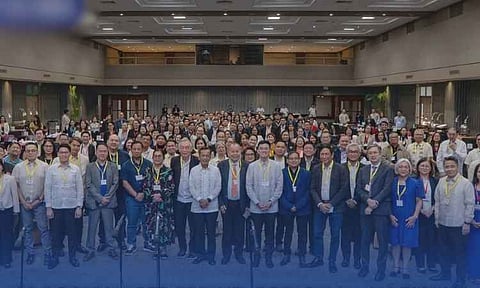


MANILA — Stronger coordination between regional priorities and national investments can help spread economic growth across the country, the Department of Economy, Planning, and Development (DEPDev) said as it convened regional and national stakeholders for the 4th Regional-National Investment Programming (RNIP) Dialogue on Sept. 24.
“The Philippines cannot afford development concentrated in a few areas while others lag,” DEPDev Secretary Balisacan said. “Each region has distinct strengths and opportunities. Realizing them requires investments that meet local needs while advancing national objectives.”
The dialogue brought together Regional Development Councils (RDCs) and officials from 10 central government agencies to connect regional priority projects with the national budget and ensure that public investments respond to development needs across the country.
RDC representatives provided feedback on project readiness, coordination mechanisms, validation processes, and the implementation of priority projects.
Since its launch in 2023, the RNIP has elevated more than 1,000 regional priority projects for possible inclusion in the Public Investment Program (PIP).
Hundreds of these projects — covering irrigation, transport infrastructure, health care and research facilities — have since advanced through the RNIP process. Of these, 438 received funding under the fiscal 2025 and 2026 General Appropriations Acts.
The recommendations from this year’s dialogue will help DEPDev refine RNIP guidelines, strengthen project prioritization, and improve coordination between national agencies and regional stakeholders ahead of the next investment programming cycle.
Projects identified through the dialogue will also feed into the updated PIP and support preparations for the fiscal 2028 budget.
Balisacan also pointed to efforts to strengthen the connection between development planning, investment programming and budgeting by improving government systems, processes and policies.
“DEPDev is working with the Department of Budget and Management (DBM) to improve project traceability, connect the RDIP (Regional Development Investment Program) and PIP more closely to budget preparation, and institutionalize these reforms,” Balisacan said. “Transparent, traceable decisions are essential to rebuilding confidence that regional priorities will lead to investment.”
DBM Secretary Kim Robert C. De Leon said the coordination with DEPDev would translate into clearer criteria for prioritizing projects in the next budget cycle.
“For investment projects, we will give premium to those that have gone through the proper planning and investment programming process,” De Leon said.
“If a project is not in PIP Online, that immediately raises fundamental questions: Did it go through the Regional Development Council? Was it properly vetted? Was its alignment with the Philippine Development Plan checked?”
“We want to strengthen that discipline in budget preparation. Public funds should go to investments that have been properly planned, vetted, and prioritized,” he said.
DEPDev is also pushing for the adoption of One Process, One Calendar and One System to bring planning, investment programming and budgeting under a more unified framework.
The framework will guide agencies and regions on the timing and sequencing of activities, project prioritization and capacity-building needs.
DEPDev Undersecretary Carlos Bernardo O. Abad Santos said the RNIP dialogue aims to turn regional concerns into practical improvements in the investment process.
“We want these discussions to go beyond identifying concerns. We want to surface practical solutions, identify institutional and policy gaps, and come out with recommendations that can make the RNIP process work better for everyone,” Abad Santos said. PR
