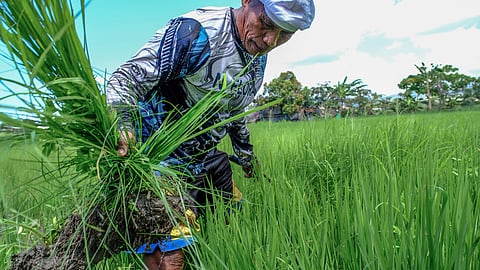


THE Department of Science and Technology in Davao Region (DOST-Davao) is urging local governments, agricultural groups, and households to adopt integrated water management and technology-driven solutions as the region faces the continuing effects of El Niño.
During the Kapehan sa Dabaw media forum Monday, Oct. 5, DOST-Davao regional director Dr. Anthony Sales called for a “whole-of-nation and whole-of-society” approach to addressing dry spells and water security.
“Because the solution to the problem shouldn't just come from the government, but from all stakeholders,” Sales said. “So we'd like to appeal to everyone: whatever we can do at our level, from our sector, let's do it so that altogether, or together with DOST, we provide the solution to the problem that we are facing.”
Sales said prolonged periods of reduced rainfall threaten the region’s water supply and food production, while excessive water use puts additional pressure on local aquifers and increases the risk of saltwater intrusion and resource depletion.
“We lessen demand for water by, in our households, trying to save as much as we can in using water,” Sales said, noting that Davao City’s shift to surface water has helped reduce pressure on deep groundwater sources.
“Because if we hadn't done this, we would continuously deplete our aquifers.”
To help communities cope, DOST-Davao is deploying research and technology developed with funding from the Philippine Council for Agriculture, Aquatic and Natural Resources Research and Development (PCAARRD).
The agency is working with farming and fishing communities to promote rainwater harvesting, surface water use, and water-saving practices to sustain agricultural production during droughts.
Sales said DOST-Davao also continues to provide Grants-In-Aid (GIA) funding to cooperatives, academic institutions, civil society organizations and local governments for community-based innovations aimed at reducing disaster risks.
The regional science agency is also promoting digital tools such as HazardHunterPH to support infrastructure planning and disaster risk reduction. The platform allows residents, farmers, and businesses to assess location-specific exposure to hazards such as landslides, flooding, and earthquakes.
DOST-Davao will showcase integrated early warning systems and climate adaptation technologies during the Mindanao leg of Handa Pilipinas, which will be held Oct. 15 to 17 alongside National Science and Technology Week.
Science and Technology Secretary Renato Solidum is scheduled to attend the event, which will bring together regional industries, local officials, and communities to explore practical disaster resilience measures.
The Philippine Atmospheric, Geophysical and Astronomical Services Administration (Pagasa) on Monday declared the end of the southwest monsoon, or habagat, signaling the transition to the dry season as El Niño continues to heighten the risk of dry spells. GRS
