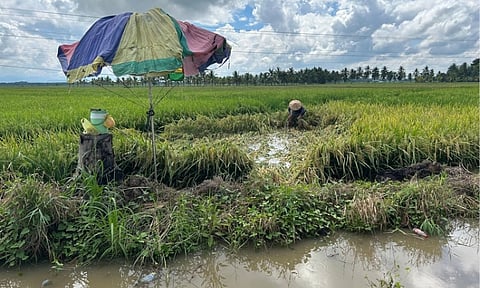


EL NIÑO has caused P584.68 million in farm losses in the Davao Region, affecting 6,205 farmers and 6,634 hectares of farmland, the Department of Agriculture in Davao (DA-Davao) said.
Joedel Leliza, DA-Davao's disaster risk reduction and management focal person, presented the figures during the Davao Peace and Security Press Corps briefing on Wednesday, Oct. 28, 2026, at The Royal Mandaya Hotel.
The total is up from about P400 million in farm losses and 3,900 farmers affected in the agency's previous report. He said the figure rose by about P200 million after the latest damage validation in Davao del Sur.
"This is higher compared to our last report na, 3,900 farmers and P400 million na damages," he said.
Rice hardest hit
Rice accounted for P390.24 million of the losses, affecting 3,793 farmers and 5,362 hectares, according to DA-Davao's damage report. High-value crops followed at P126.9 million, mostly fruits at P96.22 million. Livestock and poultry losses reached P35.22 million, and corn losses reached P32.32 million.
"So, pinakanaapektuhan po is ang rice around 390 million (pesos) and followed by high-value crops po, specifically fruits po," Leliza said. (The most affected is rice, at around P390 million, followed by high-value crops, specifically fruits.)
He said the agency logged the damage as "moisture stress" because it had seen crop damage as early as January and February, before it could use calamity funds for El Niño.
"So, since hindi pa natin pwede magamit ang calamity fund ng El Niño, so, we used the moisture stress (Since we could not yet use the El Niño calamity fund, we used moisture stress)," he said.
P274M more sought
DA-Davao's El Niño action plan carries a P729.11-million budget. Most of it, P678.73 million, goes to raising production in areas less vulnerable to the dry spell, according to the agency's presentation.
Leliza said Davao del Norte and Davao Occidental were identified as less vulnerable this year, though Davao del Norte is expected to become vulnerable by February.
Based on the DA's interventions, he said rice production in Davao del Norte is expected to rise by 20 to 30 percent this second semester.
"Syempre naman, number one talaga target and objective namin is food security (Of course, our number one target and objective is food security)," he said.
The agency is now procuring P66.34 million worth of seeds, fertilizers, and plastic drums for farmers hit by moisture stress, and has asked for another P274.09 million in quick response funds for farmers affected by El Niño, the presentation showed.
Leliza said the ongoing batch covers around 12,416 farmers regionwide.
Catch rain now
Leliza urged farmers to build even small water impounding facilities while it still rains, so they have water to use when the dry spell comes.
"So, why not harvest the rain para po ma-impound and pwede nating gamitin this ever na magkaroon ng long drought, long dry spell sa mga susunod na buwan (So why not harvest the rain so it can be impounded and used if there is a long drought or dry spell in the coming months)," he said.
He said the DA has pre-positioned open-source pumps for irrigated rice areas, and that the National Irrigation Administration plans to rotate water releases if levels in irrigation systems drop by 0.5 to 0.6 meters.
Where local governments expect water to run short, he added that farmers will be advised to switch to drought-tolerant crops such as mung beans and watermelon.
He also advised farmers to check the agency's Agri Info Davao Facebook page and its Agro-Climatic Advisory Portal, which gives a 10-day farm weather outlook.
Pagasa earlier said El Niño is expected to intensify into a very strong one and last through the first half of 2027. GRS
