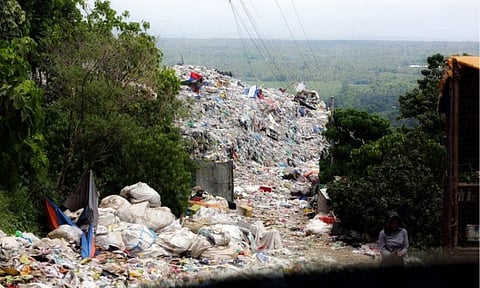


FOLLOWING a series of landfill collapses across the country, the Environmental Management Bureau Region in Davao Region (EMB-Davao) is rolling out a new risk-based monitoring framework to prevent structural failures and enforce local government compliance.
Speaking at the 8th Environment Summit on Friday, September 25, 2026, at the SM City Davao Annex Event Center, EMB-Davao Environmental Monitoring and Enforcement Division Chief Miralou Blanco presented the "SLF Risk Registry Framework" under the regional banner "e-ECO: Enhanced Environmental Compliance & Outcome".
The initiative comes as waste management challenges intensify nationwide, with the Philippines generating approximately 61,000 metric tons of solid waste daily.
Blanco told attendees that 2026 has been a sad awakening news that triggered a lot of efforts to improve solid waste management.
She pointed out that after news of landfill incidents in Cebu in January, Rizal in February, and Navotas in April, Davao Region was not spared when Davao City experienced its own incident last May.
In Davao Region, only 17 out of 49 local government units (LGUs) currently operate compliant sanitary landfill facilities. The remaining 32 LGUs rely on temporary residual containment areas or are in various stages of facility planning and construction.
Blanco emphasized that strict solid waste management directly supports Chapter 2, Subchapter 2.3 ("Establish Livable Communities") of the Philippine Development Plan (PDP).
According to the PDP Table 2.3.2 Results Matrix presented during the summit, the Department of Environment and Natural Resources (DENR) serves as the responsible agency tracking two key ecological indicators:
Starting from a baseline of 32 percent in 2021, the PDP targets increasing the proportion of cities and municipalities served by sanitary landfills to 44 percent in 2026, aiming to reach 50 percent by 2028.
Similarly, from a 41 percent baseline in 2021, the PDP sets targets for the proportion of barangays served by Material Recovery Facilities (MRFs) at 49 percent in 2026, aiming for 53 percent by 2028.
Blanco noted that without focusing on solid waste management, environmental goals for improved quality cannot be achieved, pointing out that Republic Act 9003 mandates both source segregation at MRFs and proper disposal at sanitary landfills.
To move beyond traditional checklist monitoring, EMB-Davao’s new framework introduces a predictive decision support system that evaluates five core governance areas across the region's operational landfills.
Rather than simply confirming facility presence, the system evaluates operational hazards—notifying municipal mayors and waste engineers of potential risks before structural accidents occur.
Blanco explained that EMB-Davao will look at sanitary landfills beyond ticking a checklist to undertake risk-based monitoring so that any bound incidents are reported to LGUs for corresponding action.
The agency reiterated its calling on local chief executives and institutional partners across Region 11 to update and strictly enforce their approved 10-year solid waste management plans. GRS
