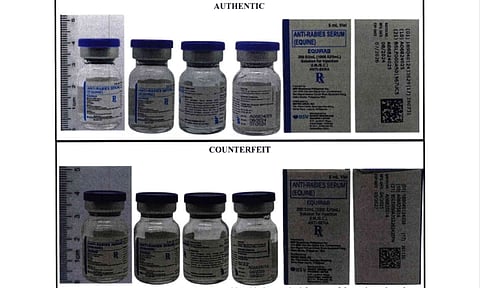


THE Food and Drug Administration (FDA) has confirmed three counterfeit drug products collected from two establishments in Davao City this year: two lots of human albumin and one lot of anti-rabies serum, an official said.
Eba Marie Antonette Inis, officer-in-charge director II of the FDA Mindanao East Cluster, gave the figures during the Department of Health (DOH) media engagement on Friday, Oct. 30, 2026, at the DOH Davao Center for Health Development, ahead of the National Consciousness Week Against Counterfeit Medicines.
A lot, or batch, is a specific quantity of a drug made in a single manufacturing cycle and identified by a unique code that allows its production and distribution history to be traced, according to US Food and Drug Administration regulations.
"For the whole Davao Region, we have five confirmed counterfeit products with four establishments po na nakuha og counterfeit products (from which counterfeit products were taken)," Inis said.
She said these were only the samples that tested positive, as more products were submitted for testing.
Asked for more data on its operations, Inis said fuller figures are still being consolidated ahead of the observance.
“So, actually ma’am, naa ta'y data on that, pero kailangan lang siya i-consolidate because actually we are preparing for the third week celebration of the counterfeit medicine (So, actually ma’am, we have data on that, but it just needs to be consolidated because we are actually preparing for the counterfeit medicine week on the third week of November),” she said.
In a report to SunStar, Inis identified three Davao City products: Albumin (Human) USP 25% Albuminar-25, 50mL intravenous solution, Lot Nos. NGC826348 and PRT279082, and Anti-Rabies Serum (Equine) (Equirab) 200 IU/mL (1000 IU/5mL) solution for injection, 5mL vial, Lot No. A06825016.
Human albumin is made from pooled blood plasma from healthy donors and is used to restore blood volume in emergencies and treat low albumin levels in conditions such as burns, according to the drug's prescribing information.
The World Health Organization says anti-rabies serum, or rabies immunoglobulin, is given with wound washing and vaccination after severe exposures such as bites.
Rabies is fatal once symptoms appear.
In FDA Advisory No. 2026-1609, posted on its website on Oct. 26, the agency warned against counterfeit Albuminar-25. It said CSL Behring no longer manufactures Albuminar, and that AlbuRx 25% 50 mL is now the only authorized human albumin product in the Philippine market; it also said the last Albuminar 25% batch supplied to the country expired in September 2022.
In Advisory No. 2026-1402, posted on Oct. 5, the FDA warned against counterfeit Equirab with Batch No. A06825016, expiring in March 2027, noting that "the concerned batch of Equirab has an authentic counterpart available in the market."
Both advisories said the counterfeits pose serious health risks when administered, and warned that "anyone found selling the said counterfeit drug product will be penalized." The FDA has issued similar warnings against counterfeit Equirab since at least 2021.
"For Davao City alone, ma'am, we are happy to say that it has decreased from the past years," she said, adding that many counterfeits were seized during the 2021 to 2022 pandemic period.
Inis said the FDA keeps its operations out of the media because exposure could compromise ongoing cases, and that its investigators go beyond retailers to trace where the products came from.
Unusually low prices are a warning sign, she said, citing anti-rabies vaccines that normally cost more than P1,000 being offered at P600.
"The price is a red flag, kay ngano man? Barato siya compared sa prevailing market price (The price is a red flag. Why? Because it is cheap compared with the prevailing market price)," Inis said.
She also cited a fake version of the anti-tetanus product Tetagam, sold cheaply in an ampule so that buyers still have to purchase a syringe.
"But ang tinuod, ang authentic na Tetagam na pang-inject punta sa tetanus, naka-prefilled syringe siya (But the truth is, the authentic Tetagam injected against tetanus comes in a prefilled syringe)," she said.
Under Republic Act 8203, the special law on counterfeit drugs, Inis said counterfeits include medicines with no active ingredient, less than 80 percent of the required amount, or mislabeled as to identity or source.
Other red flags she listed are labels in foreign characters with no translation, spelling and grammar errors, "FDA approved" claims or FDA logos on packaging, cracked or discolored tablets, and crystals forming on the tablets.
She said some vitamin C tablets discolor quickly because they oxidize easily.
"When in doubt, throw it out," she said, urging consumers to check products on the FDA portal.
She also warned against buying online and from sari-sari stores, saying the FDA licenses online ordering only for sellers with physical stores.
"But kung virtual siya tanan, virtual pharmacy siya tanan, we don't license that (But if it is entirely virtual, a fully virtual pharmacy, we don't license that)," she said.
"I'm urging everyone to please buy medicines only from FDA-licensed drug stores," Inis said, adding that consumers can report suspected fakes through the FDA website without being identified.
"We always protect our sources," she said. GRS
