
July 17, 2026. 8:00 a.m. SM Lanang.
There I was, bright and early, ready to learn how to save a life. I hate going to SM but for this, I will brave it.
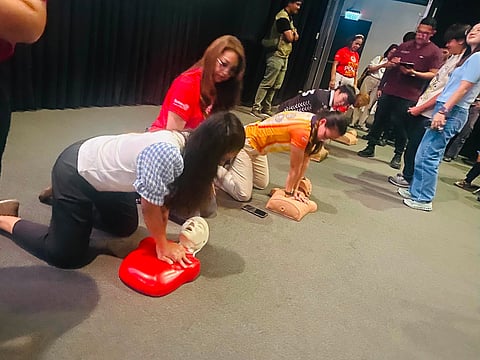
It was National CPR Day, a joint project of SPMC, the Philippine Heart Association Council on Cardiopulmonary Resuscitation, SM, and various Rotary groups. The training was free, and since the Rotary Club of South Davao is the type of club that likes to be hands-on — sometimes literally — we decided to join.
Besides, many of us really wanted to go because it can be a useful skill in an emergency when we go into the communities.
I’ve had CPR training before, but I figured a refresher course couldn’t hurt. In fact, it was a good thing I went because some of the protocols have changed, particularly after COVID.
One of the biggest changes?
No more mouth-to-mouth in the basic CPR protocol we were taught.
The emphasis is now on chest compressions. The heart needs to be kept pumping and circulating blood, especially to the brain. And apparently, when faced with an emergency, the most important thing is not to panic and stand there screaming, “What do we do?!”
You pump.
Heart attack vs. cardiac arrest. Here’s something I learned that I honestly didn’t know before:
A heart attack and cardiac arrest are not the same thing.
A heart attack is essentially a problem with the heart’s blood supply — the “pipes,” so to speak. Blood flow to part of the heart is blocked. A person may experience chest pain, shortness of breath, sweating, nausea, or other symptoms. They may remain conscious.
Cardiac arrest is different.
It is an electrical problem. The heart suddenly stops pumping effectively, and the person loses consciousness. And this is where CPR comes in.
If someone is unresponsive and not breathing normally, you need to act quickly. Call emergency services, get an AED if one is available, and start CPR.
The instructor emphasized that every minute matters. I raised my hand and asked the question that was probably lurking in everyone's mind: “When do I know if the patient is well and truly dead?”

The answer? Just keep pumping!
Don’t decide for yourself that it’s over. Keep performing CPR until trained responders arrive and take over, an AED is used and gives further instructions, or the responders determine that resuscitation should stop.
In other words: Just. Keep. Pumping.
And yes, I learned that CPR is not as easy as it looks.
You have to position your hands correctly and compress the chest deeply enough to make a difference. The recommended depth for an adult is about 5 centimeters (2 inches), while maintaining the proper rhythm and allowing the chest to recoil between compressions.
It takes effort.
A lot of effort.
After a few rounds on the training manikin, I was thinking, Okay, this person better appreciate what I'm doing. Of course, the manikin remained completely ungrateful.
We also learned the basics of CPR for babies, which requires different techniques and gentler compressions. Everyone had a turn practicing. There is something oddly sobering about practicing on a baby manikin because suddenly the whole exercise feels very real.
And that, really, is the point.
You hope you never have to use CPR. But if the day comes when someone beside you collapses, you don't want your first thought to be “I wish I had learned this.”
Just Keep Pumping!
The biggest lesson I took home wasn't complicated. Learn the skill. Practice the skill. And if you ever need to use it, act. Free classes like this are worth attending whenever the opportunity comes up. CPR is one of those skills you may never use—and hopefully never have to—but knowing what to do could make an enormous difference during those terrifying few minutes before professional help arrives.
And perhaps the training gave me another reason to take better care of my own heart, too. Because while I now know how to help someone else's heart keep going…
I'd really prefer to keep mine going without requiring CPR.