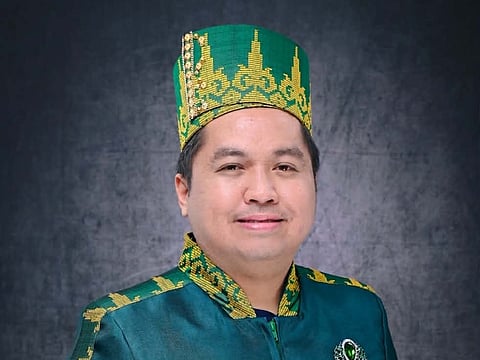


The newly enthroned Sultan of Masiu, Atty. Mohammad Ben-Usman, is a simple man. One of his recent purchases was cleaning supplies for Babu Rahman Masjid, in Teraka, Lanao del Sur, the second-oldest mosque in the Philippines. He went to the grocery himself to choose what the mosque needed, then turned to the jamah, the community of worshippers, for help with repairs and repainting.
“For me, caring for the mosque is more than simply maintaining a building,” he said. “It is about honoring a sacred space and creating a place that is beautiful, clean, welcoming and comfortable. We do it in the name of Allah, and for the people who come through its doors,” he said.
That sense of responsibility extends beyond the mosque. The sultanate remains an important institution in Meranaw society, with Lanao’s 16 royal houses continuing a centuries-old tradition of leadership and cultural stewardship. They have roles in customary law, community affairs and the preservation of Meranaw traditions. Masiu is particularly significant. Its traditional territory encompasses nine municipalities, giving it the widest reach among Lanao’s royal houses. Meranaw, also widely spelled Maranao, means “people of the lake,” referring to their ancestral homeland around Lake Lanao. The Bangsamoro government and its cultural institutions use the spelling Meranao in some official materials.
Ben-Usman came to the sultanate after a career in government and an unusually broad academic background. Before his enthronement, he served as a Customs collector in Cagayan de Oro. At Mindanao State University, he studied law and mathematics and graduated cum laude. In 2010, he was named one of the Ten Outstanding Students of the Philippines and received the national award at Malacañang Palace.
He was an exchange student at the University of Missouri–St. Louis and a visiting student at Northern Illinois University. He later returned to Mindanao for graduate studies, earning a master’s degree in public policy at the Ateneo School of Business and Governance of Ateneo de Davao University. His education and career in public service prepared him for a role in which leadership carries obligations beyond the title.
In Masiu, Lanao del Sur, becoming Sultan is not a matter of royal blood alone. A candidate must also have good character, the respect of the community and a record of leadership and service, with the backing of the royal clans.
Ben-Usman said he accepted the elders’ consensus because he wanted to honor the taritib and ijma, and the legacy of Masiu’s previous Sultans. He sees the title not simply as an honor, but as a responsibility to continue serving his people.
That responsibility shapes his priorities. He wants to focus on the poor and marginalized, the youth, peace and order, mosques and madrasas or Islami schools, and the development of local communities. He also plans to organize a youth group to give young people opportunities to develop leadership, discipline, responsibility and a spirit of service.
He aims to continue the traditional Kalilang celebration associated with Moriatao Balindong Bsar sa Masiu lineage, bringing together the nine municipalities under the Sultanate to promote unity, cultural pride and cooperation.
His wife, Atty. Rosaemmah Mapupuno Salic, a lawyer and accountant, was also installed as Potre Maamor, a traditional royal title for women, of Masiu.
For Ben-Usman, his greatest wealth is his family and friends. He credits his parents with raising eight children and instilling in them the value of education, kindness and prayer. He remembers them as honest, thoughtful and hardworking people whose legacy continues in their community.
He describes his wife as his anchor and his children as the center of his joy. His circle of friends, built through school, work and civic activities, has also been a source of advice and support through difficult times.
That belief in the value of people also shapes how Ben-Usman would spend P500. “In a world obsessed with mindless spending, the truest form of luxury lies in intentional living.” He would give P300 to three people who need it, such as a neighbor, street vendor or gas station attendant. With the remaining P200, he would have coffee and a snack at a local café, using the time to read, think and plan.
For him, money should serve two purposes: helping others and investing in yourself. And when success comes, he believes, the greater reward is using it to lift others and strengthen the community.
His indulgences are just as simple. He loves traveling to Makkah and Madinah, Islam’s two holiest cities in Saudi Arabia. He considers the birthplace and the burial place of the Prophet Mohammad respectively, more meaningful than the attractions of Europe or America. In Saudi Arabia, he is less interested in shopping than in having good coffee each day. He brings home small gifts, usually rosaries and prayer mats, for family and friends. To him, they are more than souvenirs. They are reminders of the holy cities and a way to share his spiritual experience with people he cares about.
His approach to gift-giving goes back to the best advice he received. “When I was 25, a dear friend told me to share my blessings and practice radical charity. He reminded me that learning to give is a genuine challenge. That advice changed how I see success. Ever since, whenever I have extra funds, I make it a point to be generous. True wealth isn’t what you keep in your bank account, but how much you can share to uplift the poor and marginalized.”
The best gifts he has given are equally practical. “They have no superficial flair. They are simply cash for a sack of rice or essential medicine for the poor. Nothing matters more than helping a family meet its basic needs. A sack of rice feeds a household and eases their worries. Medicine restores health and removes a heavy financial burden. True generosity isn’t about giving what looks good. It’s about responding to the most urgent needs of those who need help most.”
For all his responsibilities, Ben-Usman keeps his daily essentials simple. His mobile phone and internet maintain his connection to the people and organizations. Books and continuing education keep him learning and sharpen his thinking. Family, friends and community remain his anchor. For him, leadership means staying informed, continuing to grow and remaining connected to people.
That philosophy was reinforced by the book that has had the greatest impact on him, The Art of Simple Living.
“The book taught me that simplicity is not deprivation. It is removing what is unnecessary to make room for what truly matters. I learned to declutter not only my surroundings but also my time and attention. It taught me to focus on one thing at a time, say no when necessary and live more fully in the present. Most of all, it taught me to find gratitude in ordinary moments,” he said.
Ben-Usman also finds renewal in art, particularly works inspired by nature. They remind him of what he sees as the beauty of God’s creation and offer an escape from the noise and pressures of modern life.
When the titles, accolades and demands of public life fall away, Ben-Usman says what remains is faith, family, friends and time to think. Prayer keeps him grounded, while his wife and children give him joy. Friends and colleagues help him navigate difficult decisions. And, preferably with a good cup of coffee, he finds time to read, reflect and think about what comes next.
That same sense of purpose shapes how he views the throne. He does not see it as something to hold indefinitely, but as a responsibility that should eventually be passed on.
“I do not wish to monopolize the opportunity to serve and lead,” Ben-Usman said. “The Sultanate belongs to a continuing royal tradition, and in time, the responsibility should be entrusted to other members of our royal family who are worthy of it. For now, I want to devote myself fully to our people, strengthen our communities and help build greater unity, peace and progress. When the time comes, I would willingly pass the throne to another deserving member of our family. My tenure should not be measured by how long I held the throne, but by the people I served, the unity I helped build and the legacy I leave behind.”
