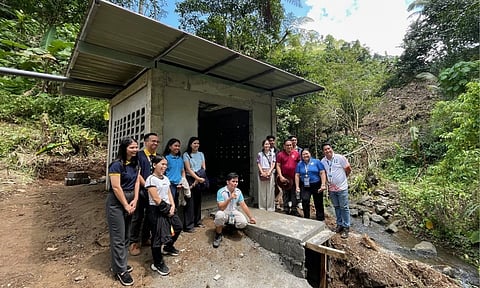


THE Indigenous People (IP) community of Purok 5 in Barangay Awao in Monkayo, Davao de Oro has long guarded the pristine waters of Awao Falls, yet as a Geographically Isolated and Disadvantaged Area (GIDA), residents spent years struggling with the limits of isolation.
Now, the IP community is taking center stage in a transformative leap toward economic self-reliance as the Department of Science and Technology (DOST) utilizes the natural water resource to establish a micro-hydro power system and bring new economic opportunities to the area.
Aligned with the directive of President Ferdinand R. Marcos, Jr. under the DOST’s Community Empowerment through Science and Technology (CEST) program, the “Microgridterprises” initiative delivers a two-fold approach designed specifically for remote areas: supplying renewable energy microgrids while establishing community-led microenterprises.
Mayan Jane Inni, provincial director of DOST Davao de Oro, emphasized that the project specifically targets off-grid communities in remote areas that lack access to electricity and require support for sustainable livelihoods.
In Davao Region, Barangay Awao in Monkayo was selected as one of the four sites, alongside Barangay Mangayon in Compostela, Davao de Oro, as well as Barangay Dagohoy in Talaingod and Barangay Gupitan in Kapalong, both in Davao del Norte.
Bringing light and power to Awao
Currently, households in the community rely on basic individual solar home lighting systems installed under a previous housing initiative. Once operational, the new hydroelectric powerhouse will generate a continuous flow of clean electricity that directly complements the existing solar setup.
According to DOST, the P8-million facility can generate 10 to 15 kilowatts of power, enough to energize around 100 households and other vital community infrastructure, like the school and the clinic.
To drive the livelihood component of the program, DOST is also turning over ₱1 million worth of processing equipment, including a wood chipper, wood dryer, and pelletizer. The agency will assist the community through technical guidance and market linkage support.
Empowering the community
The rollout of the project has brought a profound sense of pride and optimism to the village. Preparations began in 2023, with DOST conducting extensive social preparation, community organization, and capability-building workshops.
These efforts led to the creation of the Purok 5 Awao Farmers Association (Pisafa), which now counts around 150 members.
Roel Cayao, president of Pisafa, recalled the steep challenges of living off-grid before the science-based interventions.
“Dako kaayo kog pasalamat sa tanan ninghatag sa amoa og kaayuhan diri sa amoang purok kay sa unang panahon, perte jong paita dinhing dapita (I am so very grateful to everyone who brought help here to our neighborhood because, in the past, life was truly miserable in this place),” Cayao said.
He highlighted that the powerhouse will not only brighten their neighborhood alongside their homes, but will serve as the financial and operational engine for their community association.
Multi-agency partnerships
Inni underscored that long-term sustainability relies on multi-sectoral collaboration. Partner stakeholders include the local government units (LGUs) of Davao de Oro and Monkayo, the Department of Agriculture (DA), the Department of Environment and Natural Resources (DENR), and the Department of Labor and Employment (Dole).
Academic institutions like the University of Southeastern Philippines (Usep) and Davao de Oro State College (DdOSC) will also extend assistance through research, technical support, and equipment maintenance.
Beyond the CEST livelihood program, partner agencies are expected to provide additional interventions, including a poultry production business and tree seedlings to help preserve and protect the surrounding watershed area. PIA DAVAO
