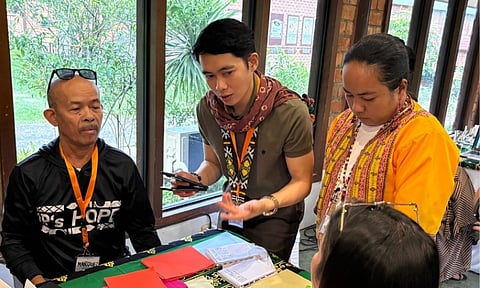


INDIGENOUS leaders from Mount Apo’s Bagobo Klata, Bagobo Tagabawa, and Obu-Manuvu communities presented policy recommendations to sustain livelihoods, protect their forests and ancestral lands, and involve women and youth in decision-making during the Mount Apo Indigenous Peoples Conference 2026 at Malagos Garden Resort in Davao City.
On Thursday, Oct. 29, 2026, the leaders discussed the state of Mount Apo and the ancestral domains they hope to pass on to future generations and recommended policies in five areas: ancestral domain protection and land management, Indigenous governance, biodiversity conservation and climate change, sustainable livelihoods, and the participation of women and youth.
The recommendations will form part of the Mount Apo Indigenous Peoples Declaration 2026 and the Mount Apo Indigenous Peoples Action Agenda 2026-2030, which organizers said will serve as shared frameworks for action across the Mount Apo landscape.
Joshua Donato, project coordinator and lead proponent of LifeBank Foundation Inc.-Sicao, said the conference produced the outcomes organizers had hoped for.
“Nakuha gyud nato atong expected outcome nga gusto namo mahitabo, katong agenda, declaration, ug katong mga policy recommendation (We really got the expected outcome we wanted: the agenda, the declaration and the policy recommendations),” Donato said.
He said the five-year action plan was drafted from participants' concerns: sustaining livelihoods in their communities, managing their land, protecting the forest, involving women and youth in decision-making, and strengthening Indigenous governance.
Selling of ancestral lands
Donato earlier said that before the conference, organizers conducted a case study on what has been happening within the Mount Apo landscape, and found cases of Indigenous Peoples selling their ancestral lands, a problem he said exists not only in Mount Apo but across the country.
“Unsa’y reason nga gibaligya nila, sa among case study nga result, because wala silay mahimo. Wala silay resources para i-till ilang land (Why did they sell? Based on our case study, because they had no other choice. They had no resources to till their land),” Donato said during the PEP Talks press conference at SM Lanang on Oct. 9.
He said half of the conference focused on Indigenous Peoples’ rights and how communities can manage their ancestral domains and resources sustainably.
He cited the foundation’s project area in Sitio Sicao, Barangay Tamayong, where Mount Talomo and the sitio’s 14 waterfalls could be developed for hiking and ecotourism, as other tribes in the country have done with their natural resources.
To MinDA, Congress
Donato said organizers will summarize the outputs and bring them to the tribal offices of the participating communities for validation. They will then share them with the policy and advocacy office of the Mindanao Development Authority (MinDA), and three congressmen could lobby for the measures in Congress.
He said existing measures for Mount Apo need strengthening, as they have been in place for a long time.
‘Who will farm?’
Indigenous leaders at the conference also raised concerns about how education is shaping the next generation.
Jeciry Antic, chairperson of the Tibolo Integrated Farm Workers Association, said that while she is glad more Indigenous children are going to school, she worries about who will be left to work the farms.
“Kung daghan na ang edukado o nag-eskuwela nga mga bata, kinsa pa man ang mag-uuma?” (If many of the children are educated or in school, who will farm then?) Antic said.
She said the imbalance is evident in the association, where many members are now professionals such as lawyers and agriculturists, while practitioner farmers have not finished their studies.
She said, for instance, parents themselves discourage their children from farming, often telling them: “Ayaw pag-trabaho sa uma, gusto ka mapareho namo (Don’t work on the farm; do you want to end up like us)?”
“I hope from this moment, nga usa sa atong matutukan kung unsa ang pag-balance sa profession into farming lifestyle (I hope that from this moment, one of the things we focus on is how to balance a profession with the farming lifestyle),” Antic said.
Jaspher Ortiz Lanzo, provincial officer of the Mindanao Indigenous People Youth Organization, said communities should look at whether IP learners are taught their language and exposed to traditional and customary practices.
“Nagadaghan naman gyud diay atong IP learners, pero sa unsa pud nga level ang ilahang involvement ug ang pagkahibalo kabahin sa tribo? Ingon ana na sad ba kataas? (Our IP learners are indeed growing in number, but is their involvement and knowledge about the tribe just as high?” Lanzo said.
He said Indigenous Peoples Education (IPEd) could still be improved, but that the push should come from the Department of Education (DepEd) itself.
“That is not something na mag-gikan sa atoa, mag-gikan gyud mismo sa agency, sa DepEd (That is not something that should come from us; it should really come from the agency itself, DepEd),” he said, noting that implementation varies across schools, with some school managements being very supportive.
Pride in the tribe
In Barangay Carmen, Baguio District, Obu-Manuvu tribal chieftain Bae Nilda Landim said barangay health workers recorded residents’ names, tribes, and places of origin, and found that many residents are Indigenous.
She said children in the community try to wear their tribal attire, while those who don't are seen as Bisaya. Parents buy them the attire so they can take part in IP activities.
“Bisan asa sila muadto sa Davao, og asa sila nag-eskwela, mahinumdoman gihapon nila nga tribo gyud sila (Wherever they go in Davao and wherever they study, they will still remember that they truly belong to the tribe),” Landim said.
Davao Region has 255,385 IP learners, the most of any region in the country, and IP learners make up 22 percent of its public school enrollment, the Second Congressional Commission on Education (Edcom 2) reported on Oct. 26.
The two-day conference, which began on Oct. 28, was organized by LifeBank Foundation Inc.-Sicao, the National Commission on Indigenous Peoples (NCIP) 11-Davao City Provincial Office, and the Mount Apo Natural Park Protected Area Management Office (MANP-PAMO). GRS
