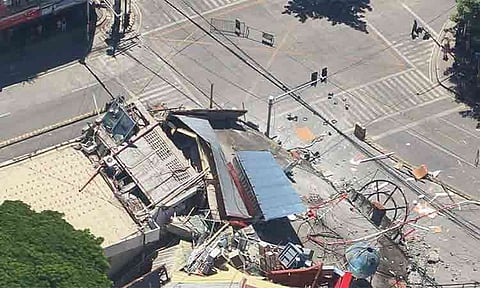

THE Office of Civil Defense-Davao Region (OCD-Davao) proposed that a 30-year Disaster Resilience Master Plan should be crafted from the barangay level up to the highest level of government as a means of preparing for disasters.
Ednar Dayanghirang, regional director of OCD-Davao, said that a disaster master plan from the barangay to the municipal and provincial levels should be crafted to prepare for disasters such as the magnitude 7.8 earthquake that struck several areas in Mindanao and the destructive landslide in Masara, Davao de Oro.
“Naa ra ta diri, dako kaayo atoang problema, naa ra ta diri ginahisgutan so we need a 30-year plan para cover tanan sa listahan sa mga unsay dapat himuon (Our major concerns are right here, and these are the issues we are discussing. We need a 30-year plan that will cover everything on the list of what needs to be accomplished),” he said in an interview on the sidelines of the Regional Disaster Resilience Information Caravan on July 3, 2026, at the Pinnacle Hotel Davao.
Dayanghirang added that he is working with the governors and mayors in developing their 30-year disaster plans in their respective areas, and found out that many of them do not have enough funding to pursue the disaster resilience plan.
However, Dayanghirang said that funding should be the least concern since planning often involves only listing the solutions to a problem.
He said that solutions could be listed in the disaster resilience plan depending on the priorities of the local government, and since it is a 30-year plan, it could be implemented annually depending on the priorities of a particular local government.
Dayanghirang emphasized that oftentimes local governments prioritize disaster-related plans only after a disaster has already occurred, while planning, operations, and preparation are rarely done.
He said planning should be conducted first at the barangay level, then consolidated at the municipal level, before being submitted to the provincial level, and finally at the regional level.
He said that he already started this campaign in 2023 for local governments in Davao de Oro, Davao Oriental, and Davao del Norte to create their disaster resilience plans, emphasizing that by having the plan in place, local governments could include it in their annual budgets.
As part of its disaster preparedness efforts, Dayanghirang said the office aims to train entire local government units (LGUs) in disaster response. He said the OCD-Davao is conducting training in various areas so that trained personnel can, in turn, train other disaster responders in their respective cities and municipalities. RGP
