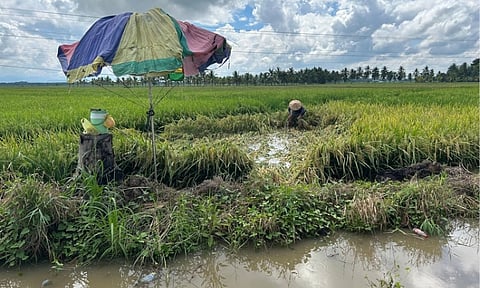


DAVAO City has enough water to ride out the early months of an impending very strong El Niño, dubbed the “Mega El Niño”, officials said. Still, they urge residents to store water, conserve it, and protect its sources before conditions worsen.
Councilor Temujin "Tek" Ocampo, chairperson of the Davao City Council Committee on Environment and Natural Resources, confirmed that continuous monthly monitoring alongside the Davao City Water District (DCWD) and bulk water supplier Apo Agua Infrastructura, Inc. shows no critical supply drops, the official said during the Isyu Karon media forum on October 2.
"As far as the flow of water from these two rivers going to the weir ng Apo Agua, wala pa tayong nakikitang (we have not seen) significant decrease that will really affect the supply of the city's potable water," Ocampo said, referring to the Panigan-Tamugan river system.
Ocampo clarified that while Apo Agua observed a minor drop in river levels, performance remains optimal across primary distribution networks. He said the city’s current reserves can withstand dry conditions through the first quarter of next year.
Robust buffer and groundwater protection
According to committee records, Davao City logged an average daily consumption of 376 million liters per day (MLD) in 2025. With Apo Agua approved for a total bulk production capacity of 681 MLD — currently delivering roughly 340 MLD into the system — the city benefits from a substantial surface water buffer.
This reliance on surface river sources allows DCWD to reduce extraction from its deep well network, giving subterranean aquifers time to recharge naturally. DCWD spokesperson Jovana Cresta "JC" Duhaylungsod noted that while drought threatens surface streams, deep groundwater reserves yielding up to 350 MLD from wells 200 to 250 meters deep act as an essential secondary defense.
"Naa tay (we have) enough groundwater reserves to cover any reduction sa (of) supply," Duhaylungsod told SunStar Davao, explaining that the combined output easily meets the city's daily operational demand of 350 to 400 MLD.
Given these reserves, Councilor Ocampo cautioned against proposals to export local water to neighboring local government units during dry spells. "Unahin natin sarili natin bago tayo mag-supply sa ibang lugar (Let us prioritize ourselves first before we supply water to other areas)," he stressed.
Regional agricultural response and trade safeguards
To safeguard Davao Region's agricultural sector, the Department of Agriculture Davao Regional Office (DA-Davao) is preparing a total budget of ₱921 million for its overall El Niño response.
During the Habi at Kape forum at Abreeza Ayala Malls on September 16, 2026, Joedel Leliza, Disaster Risk Reduction and Management Alternative Focal Person of the DA-Davao, detailed that the funding includes an active ₱729-million El Niño Action Plan currently under implementation, ₱66.3 million in ongoing procurement, and a ₱126-million budget requested from the national government.
The official explained that interventions are concentrated in unaffected zones to offset anticipated yield losses in drought-hit sectors.
Additionally, ₱40 million is earmarked for preparatory measures, while ₱9.9 million is dedicated to saving production in vulnerable zones. For high-risk farmlands, Leliza noted that farmers are supported if they choose to transition to resilient alternative crops.
“Meron tayong shifting to other crops like watermelon, soybeans, or any other drought-tolerant crops (We have shifting to other crops like watermelon, soybeans, or any other drought-tolerant crops), Leliza said, adding that interventions also include providing veterinary drugs, biologics, and feeds to protect livestock and poultry from heat stress.
Consumer protection
In response to consumer panic buying, the Department of Trade and Industry (DTI) issued a formal statement on October 1, 2026, assuring the public that national bottled water supplies remain adequate and discouraging unnecessary hoarding.
DTI stated it is intensifying price monitoring and coordinating with manufacturers to prevent artificial market shortages.
Furthermore, DTI warned sellers against overpricing plastic drums, water containers, and essential commodities during the dry spell, emphasizing that it will impose administrative fines and legal penalties on violators.
Watershed protection and upland health risks
To safeguard future supply, Ocampo urged the public to stop destructive activities inside protected recharge zones, particularly tree-cutting and illegal land conversion within the Panigan-Tamugan watershed.
Concurrently, local health authorities warned that prolonged dry spells heighten water contamination risks, especially in off-grid upland areas.
Marc Dennis Serrano, unit head of the City Health Office’s (CHO) Environmental Health and Sanitation Division, noted that while urban distribution systems remain secure, remote areas like Marilog District that rely on unmonitored springs face severe drying and potential fecal contamination.
"Ang among gi-focus is more on the contamination sa tubig, unya kaning scarcity. Siguradoon nato nga maprotektahan 'tong gamay na lang nga water na available (Our focus is more on water contamination and on scarcity. We have to make sure the little water still available is protected)," Serrano said, urging rural residents to boil all untreated drinking water to prevent acute gastrointestinal outbreaks.
To reduce watershed contamination, the CHO is accelerating its Zero Open Defecation (ZOD) campaign under Executive Order No. 32, series of 2024. While Davao City has attained Grade 1 ZOD status through shared facility access, officials acknowledged that achieving Grade 2 (one toilet per household) remains challenging in informal coastal settlements due to structural and legal building limits.
Conservation and storage
DCWD emphasized that managing water security requires mutual effort between the utility and consumers. The utility advised households to install 500 to 1,000-liter storage tanks to capture water during off-peak hours. National agencies have also begun deploying mobile solar pumps and building rainwater-harvesting structures in high-risk agricultural sectors to cushion the long-term impact on food and water security.
Agricultural drought forecasts indicate below-normal rainfall from November to January, with rainfall levels dropping to way below normal by February 2027.
State weather bureau Pagasa warned on September 23 that the active El Niño in the Tropical Pacific is expected to intensify into a very strong event between September and December, persisting into mid-2027. GRS, DEF
