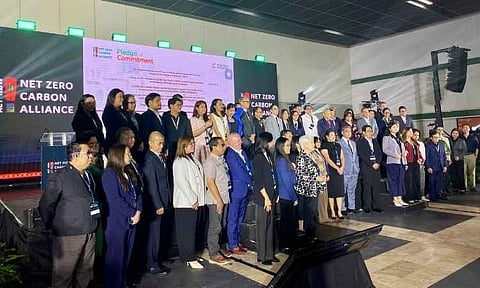

MANILA — While the Philippines has yet to set a formal national net-zero timeline, 50 companies and organizations have pledged to pursue net-zero emissions by 2050, putting the private sector at the forefront of efforts to build a lower-carbon and more energy-resilient economy.
Representatives of member companies and partner-enabler organizations of the Net Zero Carbon Alliance (NZCA) committed to the Philippine Net Zero Conference 2026 at the Philippine Trade Training Center in Pasay City.
The two-day conference, organized by the NZCA and First Gen Group in partnership with the Southeast Asia Decarbonization Exchange (CDx), carried the theme, “Bridging Gaps, Advancing Net Zero: Radical Collaboration in a Fragmenting World.”
The conference brought together corporate decision-makers, sustainability practitioners, climate advocates and small and medium enterprises to discuss ways businesses can accelerate emissions reductions through changes in energy use, financing, technology, supply chains and corporate governance.
The commitment comes as the country continues to develop its climate policies without a formal national net-zero timeline. Conference organizers said the voluntary commitments aim to help businesses achieve measurable emissions reductions and pursue long-term decarbonization.
The conference also marked the fifth anniversary of the NZCA, a private-sector coalition established in 2021 by First Gen-owned Energy Development Corp. (EDC) to help organizations operating in the Philippines transition toward net-zero emissions.
The alliance now has 50 partner companies and partner-enabler organizations pursuing their respective net-zero goals.
Eight new members joined the alliance during the conference: Enderun Colleges, Eton Properties Philippines Inc., International Container Terminal Services Inc. (ICTSI), Instep Carbon and Sustainability, MacroAsia Corp., Philippine Airlines, Philippine Trade Training Center and Universidad de Zamboanga.
The conference also introduced the first Net Zero Champions Awards, recognizing initiatives by NZCA partner companies to advance their net-zero goals and contribute to the alliance’s broader objectives.
Department of Environment and Natural Resources Secretary Juan Miguel Cuna outlined the government’s transition pathway, emphasizing the role of nature-based solutions in addressing climate change.
The DENR institutionalized nature-based solutions through Administrative Order No. 2026-30, adopting the International Union for Conservation of Nature Global Standard. The approach recognizes the role of forests and coastal ecosystems in carbon sequestration while linking environmental protection with community rights, tenurial security, and transparent benefit-sharing.
“As an archipelagic nation, our blue carbon ecosystems comprising mangroves, seagrass meadows, and tidal wetlands — provide coastal defense, storm surge mitigation, and carbon sequestration,” Cuna said.
The DENR also highlighted carbon markets as a way to mobilize climate finance and encourage private investment in low-carbon technologies.
“Carbon markets serve as a non-debt mechanism to mobilize international climate finance, encourage private capital, and accelerate low-carbon technology transfer. Carbon trading must maintain strict environmental integrity and protect local communities,” Cuna said.
The Philippines is developing mechanisms under Article 6 of the Paris Agreement, including an Article 6.2 implementation agreement with Singapore signed April 30, 2026. The agreement establishes a framework for internationally transferred mitigation outcomes.
The country is also working with Japan through the Joint Crediting Mechanism, which includes approved methodologies for reducing emissions in agriculture through alternate wetting and drying, as well as afforestation and reforestation projects.
The DENR said bilateral arrangements with New Zealand, Hungary and the Republic of Korea are also emerging. Several Clean Development Mechanism activities are being transitioned alongside new mitigation projects.
“The core principle remains firm: We welcome international capital, but we will not compromise carbon accounting integrity, double-counting protections, or national rights,” Cuna said.
The DENR called on businesses to invest in clean technologies, measure and audit their carbon footprints, and participate in high-integrity local carbon offset frameworks.
It also urged financial institutions and investors to expand access to green financing, while government agencies and local government units should integrate climate considerations into budgets, support green infrastructure and strengthen environmental enforcement.
Civil society and labor organizations were identified as key partners in implementing a just transition, particularly in ensuring that workers and informal-sector laborers receive skills training, protection and opportunities as the economy shifts toward lower-carbon activities.
The DENR also called for stronger international support through grants, technology transfers and financing for climate-related losses and damages, particularly to help the country pursue its conditional emissions-reduction target.
Allan Barcena, executive director of the NZCA, said the country’s vulnerability to climate change makes the transition to net zero important not only for environmental protection but also for energy security and business resilience.
“For a highly climate-vulnerable nation like the Philippines, achieving net zero emissions remains an indispensable shield — no longer just an environmental ideal, but a structural economic blueprint that ensures independent clean energy, long-term enterprise survival and protection from volatile global fossil fuel prices,” Barcena said.
The conference also featured discussions on mandatory sustainability disclosures, carbon-footprint monitoring, climate financing and emerging emissions-management technologies, including artificial intelligence, smart energy systems and carbon management tools.
For participating companies, the 2050 commitment places decarbonization within their long-term business planning as the Philippines continues to develop policies and mechanisms for a low-carbon economy.
Conference organizers said the collective effort underscores the role of collaboration among businesses, government, financial institutions, civil society and other sectors in advancing the country’s climate and energy goals.
Through the NZCA, partner companies receive learning sessions and tools designed to build their capacity to establish and pursue net-zero targets.
With the alliance now reaching 50 members, the private-sector coalition is bringing together corporate commitments, clean technology, nature-based solutions and climate financing as interconnected elements of the country’s continuing transition toward a more decarbonized and energy-resilient economy. DEF
