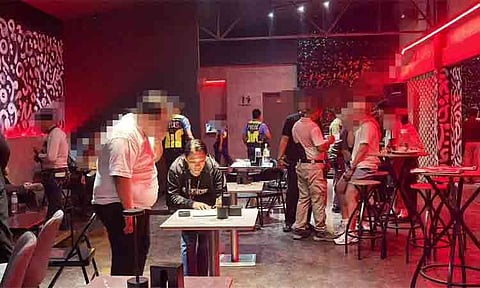


THE 21st Davao City Council is considering amendments to the city's Liquor Ban Ordinance, eyeing to impose stricter penalties on repeat violators.
The proposed amendments are currently under review by the Committee on Peace and Public Safety, chaired by Councilor Luna Acosta, and seek to strengthen enforcement against establishments and individuals who repeatedly violate the ordinance.
The city's liquor ban ordinance regulates the sale and consumption of alcoholic beverages and includes provisions intended to maintain public order and protect minors.
Jacy Jay Francia, head of the Vices Regulation Unit (VRU) and Anti-Scam Unit, said during iSpeak media forum the proposed amendments were prompted by cases in which some establishments continued violating the ordinance despite being penalized.
Francia said the current ordinance allows establishments to settle violations through fines.
“Karon man gud, ang sa current na ordinance, pwede na magbayad lang ang bar. Ang ginabuhat nila, sige lang, violate lang, tapos magbayad lang kay dako sila’g kita. This time, dili na sila pwede magbayad, but they have to face the case na gi-file sa ilaha sa city prosecutor (Right now, under the current ordinance, the bars can just pay [the fine]. What they do is keep violating the law and then just pay it off because their earnings are high. This time, they won't be allowed to just pay; they will have to face the case filed against them at the city prosecutor),” Francia said during the ISpeak Media Forum on Thursday, June 4, 2026, at the City Mayor's Office.
The proposed amendments also introduce a no-contest provision that would allow first-time violators with no previous record to accept responsibility and receive a lesser penalty.
“Likewise, sa mga violators, kaisa lang gyud sila maka-avail og no-contest provisions. Halimbawa, nadakpan ka karon, then wala pa kay records tung niagi, so, you can avail the no-contest provision. But if you avail the no-contest provision, mas lesser ang penalty (Likewise, violators can only avail of the no-contest provision once. For example, if you get caught now, but you don't have any prior record. So, you can avail of the no-contest provision. But if you avail of the no-contest provision, the penalty will be lesser),” Francia said.
Francia noted that the current ordinance does not contain a no-contest provision.
“Currently, wala tay no-contest provision pero gi-include nato na sa atuang proposed amendments (Currently, we don't have a no-contest provision, but we have included that in our proposed amendments),” Francia said.
City authorities continue to monitor establishments for compliance with the ordinance, resulting in the closure of several bars in recent years.
According to Francia, eight bars were ordered closed last year for violations, while two establishments have recently been issued final warnings.
“Last year, naa tay walo, pero karon naa natay giisyuhan na duha kabuok na bar og final warning (Last year, we had eight closures, but now we have already issued a final warning to two bars),” Francia said.
Francia said establishments that continue to violate the ordinance after receiving final warnings could face the revocation of their permits.
“Dili na suspension, revocation najud siya (It will no longer be a suspension; it will be an outright revocation),” Francia said.
The VRU has also encountered establishments that appear closed from the outside but continue operating inside, allowing violations to persist despite enforcement efforts.
Francia said some operators attempt to avoid detection by limiting visible activity while continuing to serve customers within their premises.
The proposed amendments also seek to address concerns involving private gatherings and house parties, particularly when minors are present.
Francia said private events may still be covered by the ordinance if authorities determine that minors are involved in prohibited activities.
“If naay mga minors sa sulod, target gihapon sa maong ordinance. Although private siya, pero, pag naay mga minor diha sa sulod, ma-cover na [sa balaod]. Kanang violation, dapat i-prove jud namo if there was indeed payment/bayad or transaction, kay kung wala, mahulog jud siyang private (If there are minors inside, they are still targeted by our ordinance. Even though it is a private venue, once minors are inside, the law covers it. For that violation, we really need to prove if there was indeed a payment or transaction, because if there is none, it falls strictly under a private event),” Francia said.
Francia acknowledged that regulating violations in private gatherings remains a challenge under the current ordinance, particularly when activities occur beyond the view of authorities.
The proposed amendments remain under committee review as city officials seek to strengthen enforcement and address gaps in the current ordinance. FRANCES KIM CACHILA/ADDU, SUNSTAR INTERN
