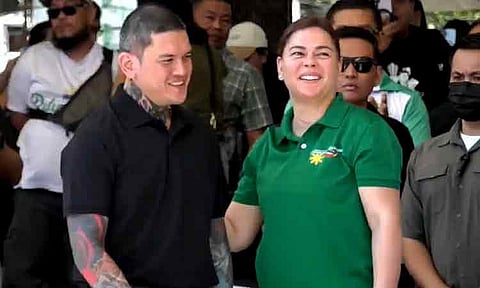

VICE President Sara Duterte and Davao City Mayor Sebastian “Baste” Duterte posted their strongest presidential preference ratings among respondents aligned with the Duterte political camp, while their support varied across other political affiliations and regions, according to the latest nationwide survey by WR Numero Research.
The findings of the WR National Poll: Philippine Public Opinion Monitor (PPOM), Issue 11, showed that 75 percent of respondents identified as Duterte supporters named Sara Duterte as their first-choice presidential candidate, while 39 percent selected her brother as their second choice.
The figures reflect the siblings' respective standings in the survey's primary and secondary presidential preference categories, with Sara leading the first-choice rankings nationwide at 42.4 percent and Baste topping the second-choice list at 21.3 percent.
However, the Davao City mayor received only 6.9 percent in the first-choice category, considerably lower than his sister's rating.
The survey also examined preferences according to respondents' political affiliations, showing differences in support among Duterte supporters, Marcos supporters, Liberal progressives, independents, and those who declined to identify their political alignment.
Among respondents identified as Marcos supporters, Sara Duterte received 11 percent in first-choice presidential preference, while Baste Duterte obtained 2 percent in the second-choice category.
Among Liberal progressives, Sara received 9 percent as a first choice, while Baste registered 4 percent as a second choice.
Independent respondents gave Sara 20 percent in the primary preference category and Baste 9 percent in the secondary category.
Meanwhile, among those who refused to disclose their political alignment, 39 percent identified Sara as their first choice, while 21 percent named Baste as their second choice.
The regional breakdown likewise showed considerable differences in the siblings' preference ratings across the country's major geographic areas.
Mindanao recorded the highest figures for both Dutertes, with Sara receiving 75 percent of first-choice preferences and Baste obtaining 41 percent of second-choice preferences.
In Metro Manila, Sara registered 43 percent in the first-choice category, while Baste received 29 percent in the second-choice category.
In the Visayas, the vice president obtained 39 percent in first-choice preferences, compared with Baste's 19 percent in second-choice preferences.
Sara also received 43 percent in South Luzon, 37 percent in Central Luzon and 13 percent in North Luzon. Baste, meanwhile, recorded 10 percent, 10 percent and 11 percent, respectively, in the second-choice category in these areas.
The nationwide results show Baste ahead of other potential presidential contenders in the second-choice category. He was followed by Sen. Raffy Tulfo with 10 percent, former vice president and Naga City Mayor Leni Robredo with 9.4 percent, Sen. Robin Padilla with 9.3 percent, and Sara Duterte with 8.6 percent.
About 22 percent of respondents did not identify a definite second-choice candidate.
The findings show that Baste's position as the leading alternative does not correspond to the same level of support as a primary presidential choice. His 21.3 percent second-choice rating is more than three times his 6.9 percent first-choice rating.
The survey was conducted from October 7 to 13, 2026, through face-to-face interviews with 1,225 Filipino adults nationwide.
The WR National Poll is part of the research firm's Philippine Public Opinion Monitor, which tracks public sentiment and political preferences across the country.
The results represent respondents' stated preferences during the survey period and do not establish how they would eventually vote in the 2028 national elections.
