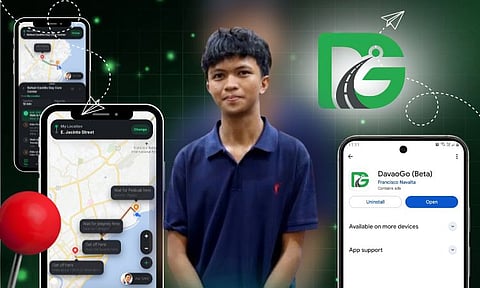


AT 17, Grade 12 student Francisco Navalta developed a free commuter app for Davao City that reached 10,000 downloads in just two weeks, earning him a commendation from the Davao City Council.
Councilor Bonz Andre Militar, chair of the council’s Committee on Information Technology, recognized the Assumption College of Davao student in a privilege speech during the council’s regular session on Tuesday, Oct. 27, 2026. The council adopted a resolution commending Navalta during the same session.
The app, DavaoGo, also known as the Dabawenyo Commuter Guide, helps users navigate jeepney and bus routes, locate stops, estimate fares, and save frequently used routes.
It also features a built-in assistant that responds in Bisaya, Tagalog, or English. Navalta named the assistant SANI in memory of his late father.
The app’s latest version, announced on its Facebook page on Sunday, Oct. 25, introduced a jeepney fare calculator for regular and discounted fares, a “report a ride” feature for complaints involving overpricing, harassment, and reckless driving, and a button for calling 911.
According to the app’s data sources page, its jeepney fares follow the Land Transportation Franchising and Regulatory Board’s fare guides. Information on Davao City Bus routes, stops, and fares comes from data the city government publishes for the Davao Interim Bus Service (DIBS).
The app uses route maps from OpenStreetMap and includes routes that Navalta compiled and checked. However, some routes still await on-the-ground verification, its data sources page said.
Commuters can also submit routes and terminals for possible inclusion in the app. An administrator must review these submissions before they become part of its routing data.
Navalta said he developed DavaoGo to help commuters, particularly Dabawenyos, as well as tourists visiting the city.
Four months of development
Navalta, a Grade 12 science, technology, engineering and mathematics (Stem) student, describes himself on his website as a self-taught developer. He started programming at 12, initially focusing on game development, which he said helped him transition to building apps.
“At the age of 12 man ko nag-start og program, nag-start ko sa game development (I started programming at 12, beginning with game development),” he said in an interview on the sidelines of the council session.
Before developing DavaoGo, Navalta established FranCheese, a business that provides development systems to more than 600 creators on the gaming platform Roblox, according to the council resolution.
In a July blog post, Navalta said the business had generated more than P1 million in total revenue.
He said he spent four months developing DavaoGo while balancing schoolwork and other responsibilities.
“Four months siya nako nga gina-develop continuously while also studying... and doing my school responsibilities (I developed it continuously for four months while studying and fulfilling my school responsibilities),” Navalta said.
One of his biggest challenges was publishing the app, which he handled himself because he developed it independently.
DavaoGo also works offline, allowing users to access its features without an internet connection.
“Available po siya offline or walay access sa internet (It is also available offline, without internet access),” he said.
The app’s official Facebook page announced on Tuesday, Oct. 27, that an iPhone version with offline functionality is in development and will be released on the App Store soon. In the meantime, iPhone users can access DavaoGo through its web version.
Navalta said he hopes the app will continue to help commuters across the city.
“Para mas makatabang gyud siya sa atoang mga Dabawenyo (So it can better serve the people of Davao),” he said.
Asked how he felt seeing his app on Google Play, Navalta said, “Excitement and then proud po sa akong sarili (I feel excited and proud of myself).”
‘Didn’t wait’
In his speech, Militar praised Navalta for taking the initiative to address commuters’ concerns.
“He didn’t wait for a big tech company or a government project to solve local commuter problems,” Militar said.
DavaoGo became available on Google Play on Sunday, Oct. 11, 2026, according to its listing. The app’s Facebook page announced on Oct. 25 that it had surpassed 10,000 downloads.
As of Wednesday, Oct. 28, the app had a 4.9-star rating based on 98 reviews on Google Play. It is free to download and contains advertisements.
DavaoGo describes itself as an independent project that is not affiliated with or endorsed by the city government, the LTFRB, the Department of Transportation, or DIBS.
The app also cautions users that its route and fare information serves as a guide. Its fare totals are estimates generated by the app, not official fare quotations.
Navalta said he is open to partnering with local government units in the future, although he has yet to read the council’s resolution commending him.
“For now wala pa nako nabasa ang resolution (I have not read the resolution yet),” he said.
Still, he said he looks forward to finding more ways to help the city.
“As long as makatabang siya sa atoang dakbayan (As long as it helps our city),” he said.
The city government launched its own DC Bus Tracker portal on Aug. 17, 2026, allowing commuters to monitor the real-time locations of city buses. GRS
