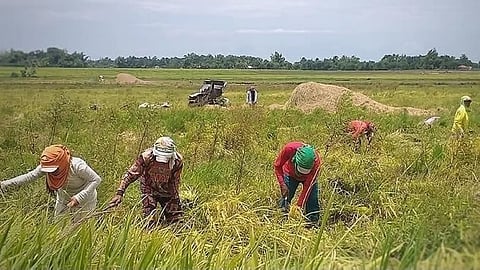


DEPARTMENT of Agriculture (DA) Secretary Francisco Tiu Laurel Jr. has assured the public that the country has sufficient food supply to weather the Super El Niño phenomenon, which started this October and could last until March 2027.
In a press briefing in Malacañang on Monday, October 5, 2026, Laurel said the government is maintaining food supply buffers, with the country currently holding about 75 days of rice supply, 125 days of chicken, 170 days of pork, and 90 days of corn.
“If we are able to maintain this, there’s no reason to panic actually,” he said.
Laurel said President Ferdinand “Bongbong” Marcos Jr. has ordered concerned government agencies to develop a work plan based on the projected effects of El Niño on farmers and fisherfolk and the interventions that can be provided to them.
Of the DA’s P45-billion request under the UPLIFT program to support farmers and fisherfolk affected by El Niño and sustain agricultural production, P6.2 billion has already been released, Laurel said.
The DA expects an additional P10 billion for current El Niño interventions, including solar irrigation, solar pumps, solar aerators and additional biofertilizers to help farmers maintain production amid possible water shortages and support fisherfolk whose operations may be affected by extreme weather conditions.
Laurel said the DA is also coordinating closely with the Department of Labor and Employment (Dole) to aid farmers who are unable to plant amid the drought.
Under the work plan ordered by Marcos, some TUPAD jobs may be offered to farmers and fisherfolk during the peak of El Niño, allowing them to work on canals and land preparation for the next planting season while they are unable to plant.
In areas where planting remains possible, farmers will be provided subsidies for fuel, fertilizers, transportation and seeds.
“We will be doing cloud seeding to make more water fall over our agricultural lands. But besides that, we are also doubling down on interventions in areas with water. Meaning, we will increase the amount of seeds per hectare and use more fertilizer, then hopefully they will be able to produce more in areas that still have water, to somehow augment the areas that have no water,” he said.
Marcos also ordered the National Food Authority (NFA) to increase its palay procurement and warehouse capacity to build up the government’s rice buffer stock.
Laurel said the DA will continuously monitor rice supply and prices, with wet palay currently ranging from P16.50 to P20 per kilo, compared with around P8 to P12 per kilo during the same period last year.
“In general, we’re okay now,” he said.
“So there is no reason to restrict importation. But of course, we have appealed to our importers that during this harvest season, if possible, they reduce their importation of these products, which will help our farmers,” Laurel added.
Meanwhile, Palace Press Officer Undersecretary Claire Castro said the public has nothing to worry about amid the strong El Niño phenomenon.
“We are already accustomed to El Niño, but of course, its intensity varies. As we have been saying, climate change is also affecting us, and weather patterns are changing. But the government is here to make sure that we are all prepared,” Castro said in Tagalog.
“There is no need to panic-buy, and people should not do so because it could only cause unnecessary fear among our fellow Filipinos. Instead of preparing properly, we might end up becoming more fearful,” she added.
According to Department of Science and Technology (DOST) Secretary Renato Solidum Jr., all provinces across the country are expected to experience drought by the end of March 2027.
Currently, the National Disaster Risk Reduction and Management Council (NDRRMC) said 106 local government units in Cagayan Valley, Calabarzon, Bicol, Soccsksargen and Caraga have declared a state of calamity due to dry conditions.
The disaster bureau said 104,149 families or 388,375 individuals have been affected by El Niño, particularly in Cagayan Valley, Bicol, Calabarzon and Caraga.
Agricultural damage and production losses in the affected regions were estimated at P5.56 billion, the NDRRMC said.
It said 201,322 farmers and fisherfolk have been affected nationwide, with more than 223,497 hectares of crop areas damaged.
Of the total affected farmland, 41,164 hectares suffered total crop loss with no chance of recovery. (TPM/SunStar Philippines)