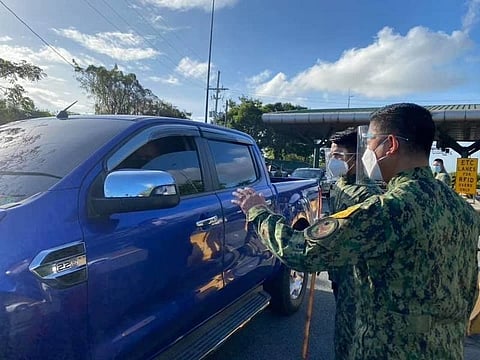


POLICEMEN began enforcing strict border control protocols at all points of entry to Metro Manila at 12:01 a.m. Sunday, August 1, 2021, six days ahead of the reimposition of an enhanced community quarantine (ECQ) in the region in a bid to curb transmission of the Delta variant of the novel coronavirus.
Quarantine control points (QCPs) were set up at borders of the National Capital Region (NCR) with the provinces of Cavite, Bulacan, Laguna and Rizal.
Only authorized persons outside residence (Apor) with IDs issued by regulatory agencies, and valid IDs or pertinent documentation issued by establishments allowed to operate under ECQ are allowed to pass through the checkpoints.
“Those found to be un-authorized person outside of residence (UPOR) will not be allowed to pass and will be asked to return to their homes,” said Department of the Interior and Local Government (DILG) secretary Eduardo Año.
“We have instructed all QCPs to allow the unimpeded movement of cargo trucks and delivery vehicles across all our checkpoints,” he added.
Metro Manila, home to around 13 million people, will revert to ECQ on August 6 to 20. It is under general community quarantine (GCQ) with heightened and additional restrictions until August 5.
In the amended guidelines on the implementation of community quarantine in the Philippines issued by the IATF on May 20, areas placed under ECQ should observe the following protocols: