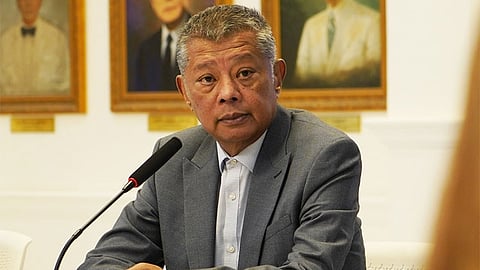


THE Office of the Ombudsman is launching a “budget watch” following the recent ruling of the Supreme Court declaring key budget provisions of the General Appropriations Acts (GAAs) for 2024, 2025 and 2026 unconstitutional due to increases made by Congress.
In a press conference Monday, October 26, 2026, Ombudsman Jesus Crispin Remulla said he will appoint a group to look into the high court’s decision and determine possible wrongdoing involving public funds.
“Kaya nga ngayon, we're starting the budget watch. Pinapanood na natin yan, which didn't happen before. And dito, with the decision, we will look, we will appoint a group, I will compose a group that will study the Supreme Court decision and the budget that came with the decision para mapag-aralan natin husto in detail,” said Remulla.
(That's why we're starting the budget watch now. We're monitoring it, which wasn't done before. With this decision, we will appoint a group that I will form to study the Supreme Court decision and the budget provisions covered by the ruling so we can examine them thoroughly and in detail.)
“Ang mabigat kasi dyan pag nag-game nga nila yung system, gina-game nila, ‘yung ginawa nila na nilalagay sa unprogrammed ‘yung mga mahalagang proyekto ng gobyerno para ilagay nila ‘yung flood control, talaga masama talaga nangyari dito. Those are the things that we will look at,” he added.
(The serious concern is that they manipulated the system. They placed important government projects under the unprogrammed appropriations to make room for flood control projects. What happened here was really bad. Those are the things that we will look into.)
The Supreme Court earlier declared the following unconstitutional:
* The 2024 General Appropriations Act (GAA) because of Congress’s increase of unprogrammed appropriations by P449.5 billion, which resulted in an increase in the President’s total recommended appropriations.
* Special Provisions 1(a) and (b), Chapter XLIII of the 2026 GAA, which authorized the release of unprogrammed appropriations under conditions that justices found overly broad and insufficiently restrictive.
* The 2025 GAA because of Congress’s increase of the Special Road Fund by P17.99 billion, which also resulted in an increase in Marcos’ total recommended appropriations.
The high court, however, clarified that unprogrammed appropriations are not unconstitutional in themselves but must be subject to stricter safeguards to prevent excessive government spending and ensure transparency and accountability in the use of public funds.
It permanently prohibited the Senate, House of Representatives, Office of the Executive Secretary and acting secretary of the Department of Budget and Management from implementing the invalidated provision of the 2026 GAA.
The SC said the criminal, civil or administrative liability of the authors, proponents or implementers of the challenged appropriations remains subject to the findings of the proper tribunals.
Remulla maintained that the budget is primarily the responsibility of Congress, which scrutinizes the bill submitted by the Executive Department.
“Ang presidente kasi just submits the bill, the proposed bill to Congress. The action goes on inside Congress. And it's very hard to follow the action kasi may kanya-kanyang tempo sila eh. Especially for those who are scheming to add things and subtract things. Kasi ang budget, zero sum. Pagka nagdagdag ka, may babawasan ka,” he said.
“No doubt, the budget is not perfect as submitted. You can actually amend it. Kaya may period of amendment yan. Kaya lang, pagka bad faith na yun ang nangyayari, when they're already playing around with people's money. So for the people who game the budget, we will study how to go after them,” Remulla added.
Before the press conference, Remulla signed a memorandum of understanding (MOU) with the Justice Sector Coordinating Council (JSCC), composed of the Supreme Court, Department of Justice (DOJ) and Department of the Interior and Local Government (DILG), to strengthen the government’s fight against corruption, address delays in corruption-related cases and improve coordination among key institutions in the justice system.
Remulla emphasized that fighting corruption requires a coordinated approach involving investigation, prosecution, adjudication and enforcement, alongside stronger measures to prevent wrongdoing before it occurs.
Under the agreement, the participating institutions will strengthen cooperation in addressing bottlenecks in corruption-related cases and improving secure information-sharing and digital systems.
As a member of the JSCC, the Office of the Ombudsman is set to develop joint initiatives involving financial crimes, asset recovery, cyber-enabled corruption and digital forensics.
Remulla stressed that the partnership must deliver concrete improvements in the administration of justice.
“Corruption does not operate within the boundaries of a single government agency. Neither should our response to it,” Remulla said.
“We cannot simply wait for public funds to be stolen, government services to be compromised or public trust to be destroyed before we act,” he added. (TPM/SunStar Philippines)